

How often – if ever – do you consider the lasting effects of slavery on society? If you’re like most people, probably hardly ever. Earlier this month I attended the event ‘Slavery – a shared history’ (originally in Dutch, ‘Slavernij – Een gedeelde geschiedenis’) in the Tropenmuseum in Amsterdam. That day those lasting effects were considered a lot.
It’s a topic I’ve been interested in for a long time, maybe because I lived in several of the countries involved in the Dutch Trans-Atlantic slave trade: such as The Netherlands, Suriname, South Africa, (Malaysia?) and Ghana. It spans centuries, it spans the globe, affected the lives of millions… but the Dutch can’t really feel it. We can still enjoy the spoils – like the buildings in the centre of Amsterdam or other Dutch towns – yet somehow we don’t really discuss it. It’s briefly discussed in history class (though in some cases without actually stating that the Dutch were part of those Europeans involved!) and that’s that. No more.
So it was awesome to see that the room was filled with people. In fact, it was sold out. Clearly the topic still draws people’s interest. Even plenty of white people, like me, showed up to think about how we can address the topic in museums, education and culture. And let’s be honest here, it’s us white folk who have the most to learn, the most to listen. Those on the non-priveledged side get reminded of that history waaaaaaay more frequently. So the crowd is a good start.
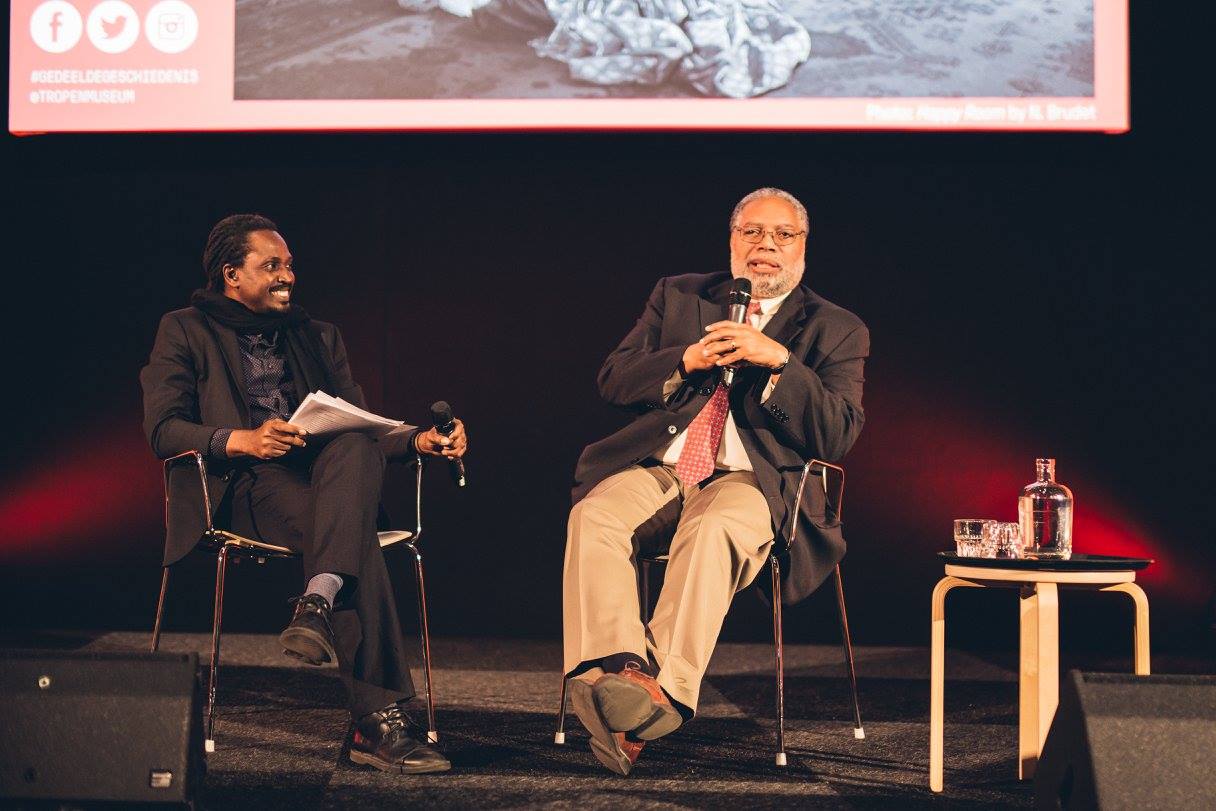
The opener is an interview with the director of the Smithsonian National Museum of African American History and Culture, Dr. Lonnie Bunch. He’s interviewed by Wayne Modest (I’m a big fan – so I’m excited). Their talk is mostly about realising the Smithsonian museum in Washington DC; making the idea a reality. Politicians had to be convinced that the story of African-Americans is 1. worth telling; 2. an American story (part of THE American story even) and; 3. is worthy of a spot on “the Mall” in Washington DC. Getting all of that done takes years, apparently.
The bit I enjoyed hearing about most was how they created a collection of objects with which to tell the story from nothing. They gathered the collection having an Antiques Roadshow-type tour through the country, calling on people to share historical objects they might have in their basements and attics. They found these in the thousands. It must have been a fascinating process.
Though I really enjoyed hearing Dr. Bunch’s perspective and experiences, I have one word of caution. The American experience is very different to the Dutch. I think the history of slavery is more visible in US society, those places and people are still there. Here in the low countries, we feel more removed. The taking and moving of people as property happened elsewhere; we just saw the riches here at home. This difference in experience is not to be underestimated – I think that looking at the American experience can be interesting, but it no solution for our own needs.
During one of the breaks, we were treated to a performance by spoken word artist Mariana Hirschfeld, from Rotterdam. She’s 21 with slicked-back hair and a determined look on her face. She showed us that being young can also mean being wise, eloquent and having epic flow.
Other speakers I enjoyed included Gloria Wekker and Quinsy Gario. Google them, they’ve got good things to say.
The final panel discussion, however, seemed to revert back to that same discussion – do white people recognise they discriminate and should they feel guilty? I’ve seen more of these panels and they often seem to go back to that same issue. Yes, it’s clear that certain people are discriminated against because they’re black. And yes, this is a legacy from centuries of suppression and dehumanisation. There are some major misconceptions in our society and these should be dealt with. I understand that the frustration of this unrecognised discrimination leads to anger. But I also see how that frustration and anger does not sway those who not see it in the first place. I already agree (and I think most people in that room did too), so this does not bring us further. We’re here to hear what’s next. Those who don’t encounter this issue don’t experience the frustration and therefore get turned off by the anger. So how do we make sure we don’t preach to the choir and have conversions with others?
 Brain & Guts