

I recently attended the recording of BBC World Questions, for radio BBC World Service, here in Amsterdam. Hosted in a former church, now home to the event space called De Rode Hoed, a live and rowdy audience was only barely kept at bay by radio host Jonny Dymond. He moderated a discussion between the four panellists and an engaged audience. The talk proved that it’s tough to listen to those you disagree with.
Framed by the BBC within “the aftermath of a fiercely fought election”, the discussion centred around the divisive topics of immigration, national identity and Islam in the Netherlands. These topics were sure to bring out strong responses from those in the room, as was proven during recording. We were prepped well, with producers reminding us to “speak with respect, listen to what others have to say and to be quiet when so told.” But once the discussion got going many could not follow these instructions and just could not stop talking. It’s apparently hard to stop sharing when you’re passionate about a topic.
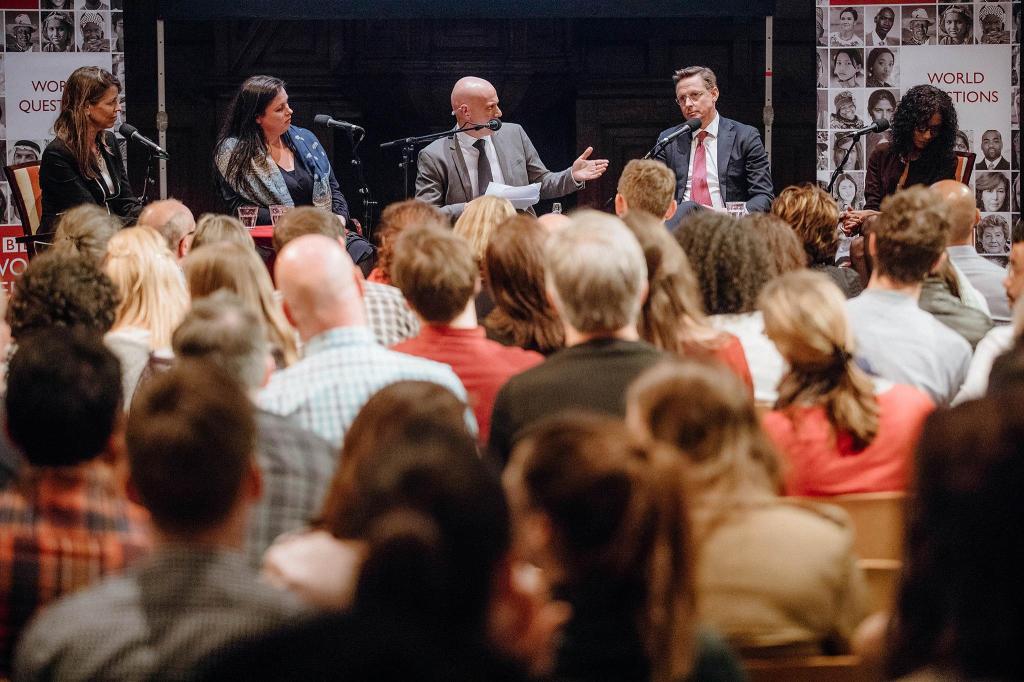
The panel was made up of three women and one man, a refreshing unbalance to counterbalance the usual formation of panels. On stage were Han ten Broeke, member of Dutch Parliament, member of the VVD (a liberal right party) and VVD spokesman on Foreign Affairs; Annabel Nanninga, right-wing journalist and commentator; Sylvana Simons, television presenter and founder of political party Artikel 1 (with a strong focus on diversity and identity politics); and Petra Stienen, author, Arabist and member of the liberal centre/left party D66.
To be clear, I tend to lean away from the right of the political spectrum – and so did, quite clearly, most of the audience in the room. Audience members were sensitive to terms like “they” and other terminology that reflects a grouping of certain members of society. The more right-leaning Han ten Broeke and Annabel Nanninga were boo-ed regularly for their use of certain terminology. The BBC was hoping for this response, of course, picking out those questions from the audience that would draw out heated arguments, mostly centred around racism and anti-Islam sentimentalities.
I was positively surprised by Syvana Simons, a controversial character in the media. She has a strong focus on issues of ‘otherness’ and is vocal on issues such as discrimination, zwarte piet and words like “they” when referring to a minority group. She risks being seen as annoying, by pointing out each and every use of words that could exclude or marginalise, but she proved she had a point. Once she got me to start noticing the terminology and how often it’s used I could not help but agree with her. I noticed just how much I had been swayed by public opinion about her. I found she came across as intelligent, cohesive and totally on-point when it comes to the Dutch using exclusive language.
The validity in Simons’ points was made clear by Annabel Nanninga, who least impressed me. She clearly fails to recognise that some might experience the world differently. She sees things from her own perspective and fails to grant others the opinions or feelings that come from those different experiences. She always wanted to talk but not listen.
Another panellist to impress me was Petra Stienen. To be fair, I had previously met her and she was a speaker at a debate I organised in Brussels. She’s knowledgeable, calm and refreshingly balanced to have on a panel. Especially the calmness is welcome during discussions like these. When Annabel Nanninga, who sat next to her, spoke using some very negative language Stienen turned to her and said: “thank you for sharing that, though I disagree it’s important that we know how you feel”. And that, for me, was the most valuable moment of the entire debate. How often have you experienced a debate where someone hears the other out and respectfully disagrees?
As we know, social media already filters most of what we get to hear and see, so we need to break our bubble and do what Stienen did: listen and thank them for sharing their view. We might disagree (strongly!), but it’s important to know what others think. As soon as we stop listening we’ll never come to solutions. I guess the producers knew this all along: “speak with respect, listen to what others have to say and to be quiet when so told.”
Want to listen to the radio broadcast? Click here: http://www.bbc.co.uk/programmes/p04yph9r
 Brain & Guts