
My great-great-grandmother’s name was Wilhelmina Maria Helena de Jongh Okhuysen and I have her photograph. An elegant and poised picture. She lived on Java in the Dutch East Indies, in what is now Indonesia. She married Wilhelm de Jongh with whom she had eleven children, one of which was my great-grandmother ‘ouwe oma’ (‘old grandma’ in Dutch). She was a rich widow who owned 8 houses throughout the island, all of which got lost during the Indonesian war for independence. She always wore her hair in a bun and a traditional sarong at home. These are snippets of her life I heard from my great-uncle, but I sadly know nothing about her parents.
One of my favourite TV shows, in the UK known as ‘Who Do You Think You Are’ (the BBC version – not the US version!) and in Dutch ‘Verborgen Verleden‘, follows celebrities during their search for their family history. Instead of plotting names and dates on a graph, they follow the stories of two to three selected ancestors. The celebrity chases a trail of documents to piece together the events and circumstances of a life lived by someone connected through DNA. It’s fascinating to see that each time, by the end of the show, people suddenly feel connected to history. Once presented through the lens of someone genetically connected to you history feels more human to them.

Wilhelmina Maria Helena de Jongh Okhuysen 
Maria Jaconina Biemond & Jean Louis Bienfait
Naturally, I started thinking about my own family history. I was lucky enough to know two of my great-grandmothers, one either side of my family tree. They both got to be two-hundred-and-two years old (yay genes!). With the use of notes scribbled by grandparents, official papers unearthed in attics and online archives, I managed to trace several of the branches of my ‘tree’ up to the 17th century.
There were no royals to be found, though it does seem that most branches of my family seem to have done alright. Well enough to be recorded at least, knowing that the poorest of society often left no documentation. I found out that my ancestors were carpenters, tailors and preachers, others had titles such as Director of the Amstel Brewery, head of the Dutch Bank, owners of a family-run shipbuilding company, owners of a family-run tram and car bodywork factory or civil servants in the East Indies. These people, all men, seem to have done well for themselves.
The women are a little more difficult to find out about, simply because they often didn’t have an occupation to mention. My third great-grandmother, Agata Maria Haze, does get a mention in the Haarlem census. Her profession is recorded as “tapster” (a barmaid). Interestingly, several years later, she is also mentioned in the records, this time as “an investor in the bank”. This leads us to assume she did well for herself!
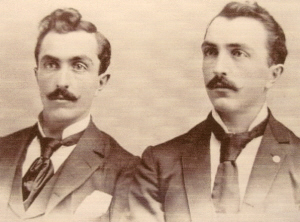
Though records are good for mapping out the family tree, it’s the stories and little details that bring this history to life. Knowing that my grandpa’s mother was a beekeeper, that my great-grandparents had their engagement photos taken on the Leidseplein here in Amsterdam, that grandma’s mother was an avid painter and that some of her delicately painted crockery is stood on my table right now. A picture of my American great-great-grandfather, Homer, shows him with his twin, Omer. Homer’s messy hair makes me imagine he must have been a bit of a goofball. Reading in the records that a couple got married on a Saturday in June brings them to life; it makes them more relatable.
My search continues. I’d love to know more about the details of those who went before me. Their connection to me keeps history alive.
 Brain & Guts