

Beads are tiny physical objects which have been part of the human experience for thousands of years. In pretty much every culture they have been crafted, traded, worn, owned, passed on, lost or even buried. Beads can tell a history of the world, be symbols of personal religious devotion, give insight into social rituals or be marks of a personal style and identity. As such, beads are the earliest evidence of abstract thinking, serving as tokens for concepts of status, prestige, protection or beauty.
By contextualising one small bead you can start to understand a much larger picture.
My project idea is to create a string of stories using beads to show how our histories, cultures and stories are connected.
Possible angles
Economic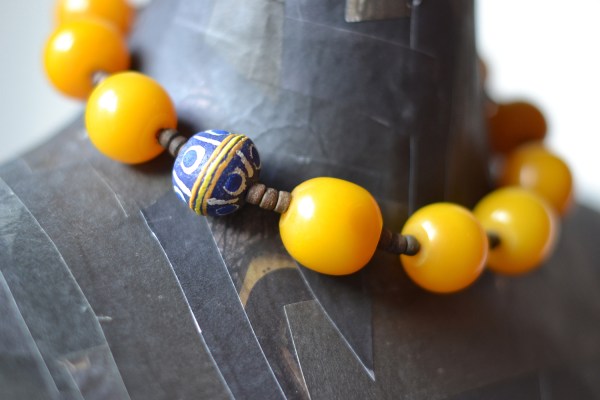
Trade connections between people can be traced through to prehistory. In fact, in 2014 it was published that a Danish Bronze Age burial from to 3400 years ago contained beads made from materials sourced in Afghanistan and crafted by workers at King Tut’s court in Egypt. On the flip side, Nordic amber beads were found as far as Syria and ancient Greece. The world has always been fluid, meaning that boundaries between people and trade were much more flexible than we previously thought.
Beads make for great trade objects, as they are durable, portable, made of scarce materials like amber, lapis lazuli or coral. Additionally, they are easy to recognise and simple to standardise. Perfect to use like money. Actually, there are unproven rumours that beads were used to buy land and people during the European colonial era.
A fun fact is, for example, that archaeologists in New York have been finding beads from Amsterdam for decades. These beads, produced by Venetian glass blowers in the Dutch capital, were apparently made especially for the local Native Americans in ‘new’ Amsterdam to trade for fur.
 Craft
Craft
The craftsmanship that went into making beads changed once people started settling down and had the riches to pay people to specialise. Take the mosaic bead for example. Often called a “millefiori”, Italian for ‘a thousand flowers’, this type of bead was already being produced by the Sumerians in 1500 BC Mesopotamia. The technique travelled, through ancient Egypt and Syria and the Roman empire. By the 14th century they were making glass beads in Murano in Venice, which for centuries was the centre of glass and bead making. Glass beads, like millefiori and the chevron bead, were also produced in Bohemia and here in Amsterdam. Artistic centres shifted over time, but Sumerian goldsmiths influenced how jewellers work today
Cultural Context
Though my knowledge here is slim, there is surely plenty to be found about the cultural significance of beads. Especially in Ghana, where a stayed for some time, beads were part of daily life. Women wear strings of beads around their waist, which are for their husband’s eyes only. Large decorative powder glass Krobo beads, which might be made at the Cedi bead factory, are piled on and serve local chiefs as a sign of prestige.
Connection to slavery
As I’m from Amsterdam, I’m obviously fascinated by the fact that there’s a history of beads here, which can be traced from here across the globe. It’s not necessarily a happy history, though. For starters, many types of beads that are currently worn, produced and given great social status in Western-Africa were actually first taken there centuries ago by European traders. They came to buy gold, ivory and… people. Beads are therefore also strongly linked to the history of slavery.
Another example are the blue beads of St. Eustratius, an island in the Caribbean. The Dutch WIC used the blue five-pointed beads for trade, including the trading of slaves. The story goes that the enslaved people were actually paid a small sum of these blue beads, to keep them connected to the island. Wives could be bought using the beads, with the common aim to have a string to go all the way around her waist. Once slavery was abolished the formerly enslaved supposedly threw them into the ocean, where these types of beads can still be found. Whether the story is true is hard to prove, but it’s interesting that the beads went from being a slave trade commodity to part of an act that symbolised freedom from that same system.
Religious
The English word for “bead” actually comes from the Old English word for prayer: “bede”. Many of the world’s religions have their version of prayer beads. The Catholics have the rosary, the Muslims the misbaha or tespih, the Buddhists and Hindus the japa mala. Though without religious or ceremonial purpose, in Greek and Cypriot culture they have “komboloi”, or worry beads, which help to pass time by manipulating the string of bead in a particular way. A method which is in fact similar to many of other religious uses.
Sources
- Dubin, Lois Sherr, 2006. The History of Beads: From 30,000 B.C. to the Present. Soft cover ed. London: Thames & Hudson.
- Oneindig Noord-Holland [online]. Available on: http://onh.nl/nl-NL/verhaal/1553/bijzondere-17e-eeuwse-bodemvondsten-uit-s-graveland [accessed on 23 March 2018].
- Mol, Angus; Morsink, Joost; Samson, Alice Dr., 7 May 2016. Episode 7: A Blue Bead from Statia, A History of the Caribbean in 100 Objects [podcast]. Available on: http://www.shoresoftime.com/portfolios/episode-7/.
- Larson, Vanessa H, 19 April 2018. ‘One of the most important’ sets of Middle East artefacts unveiled, The Guardian. Available on: https://www.theguardian.com/artanddesign/2018/apr/19/middle-east-artifacts-penn-museum-unveiled.
- History of Venetian Glass Beads, Glass of Venice [online]. Available on: https://www.glassofvenice.com/venetian_beads_history.php [accessed 23 May 2018].
- Varberg, Jeanette; Kaul, Flemming; Gratuze, Bernard, 8 December 2014. Danish Bronze Age glass beads traced to Egypt, ScienceNordic. Available on: http://sciencenordic.com/danish-bronze-age-glass-beads-traced-egypt.
- Kennedy, Maev, 20 August 2013. Ancient Egyptian beads are oldest iron objects found, The Guardian. Available on: https://www.theguardian.com/science/2013/aug/20/ancient-egyptian-beads-museum.
 Brain & Guts