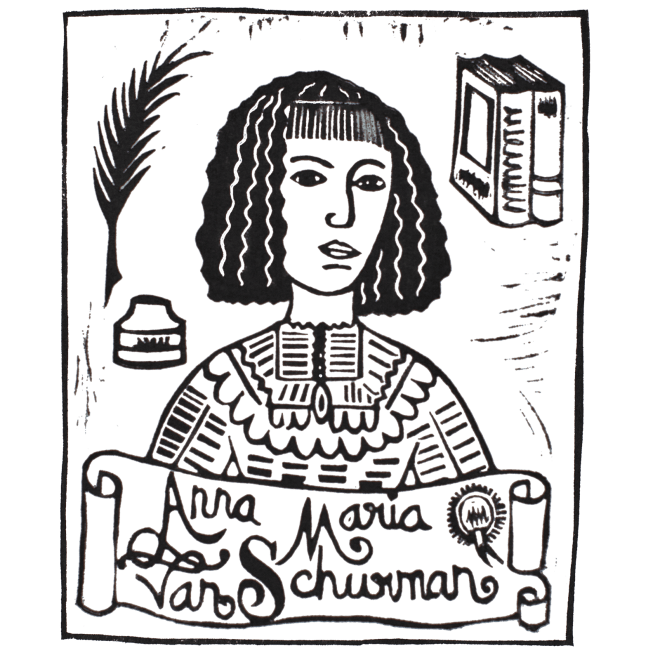
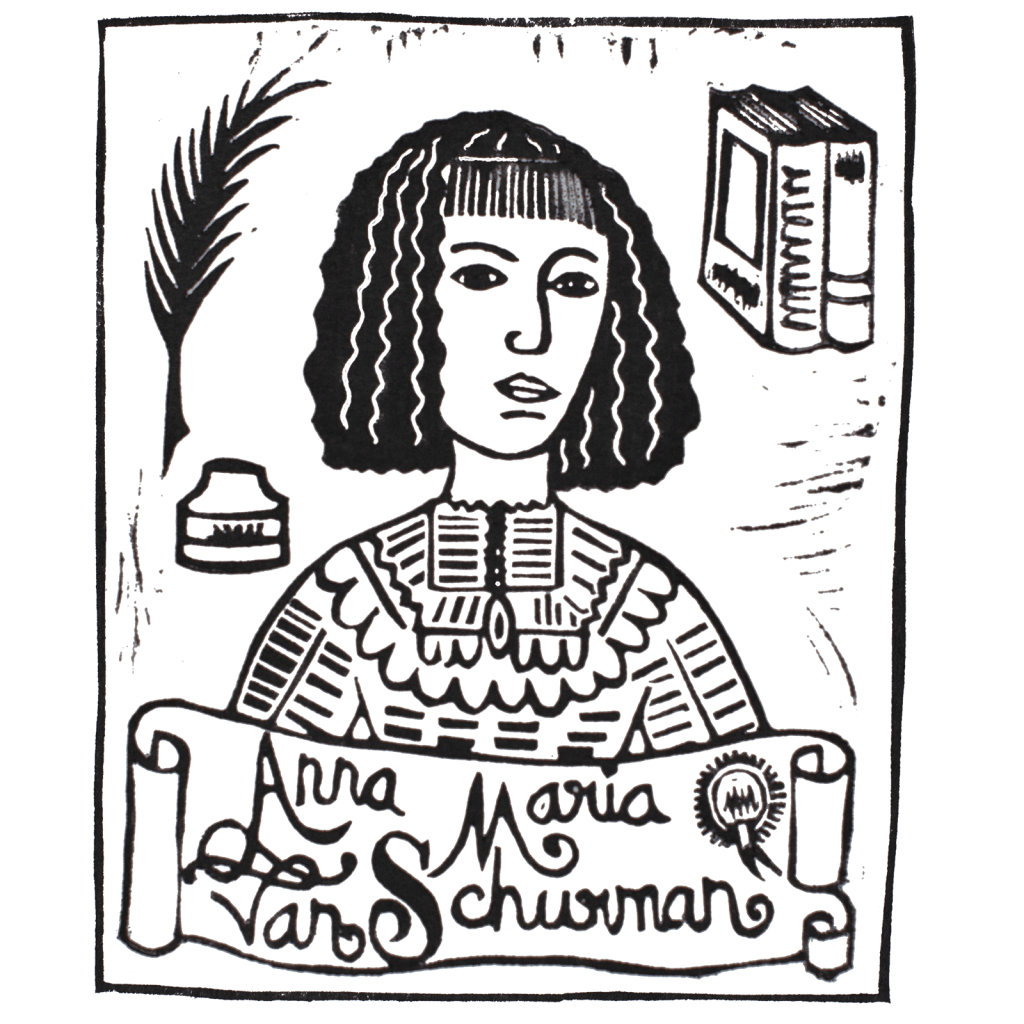
Anna Maria van Schurman (1607-1678) was a skilled artist, thinker and avid letter writer. Known now by some for her artworks, including several self-portraits, during her time she was well-known for writing a published thesis on why women’s minds were suitable for science and literature.
From her Utrecht home, she exchanged letters with prominent European figures of the time, such as Jacob Cats, Constantijn Huygens, René Descartes, the Polish Queen Ludwika Maria and Christina of Sweden. Her “disserto” had an influence across Europe and she kept up her plea for allowing women to study at educational institutions.
Woman has the same erect countenance as man, the same ideals, the same love of beauty, honor and truth, the same wish for self-development, and yet she is to be imprisoned in an empty soul of which the very windows are shuttered.
Anna Maria van Schurman
She was instrumental in the setup of Utrecht University and was the first Dutch woman (and potentially even first European) woman to study at a university. Due to her exceptional intellect, she easily achieved the level required to attend university. Though allowed to attend, she did have to sit behind a screen and would receive a diploma. She was still a woman, after all.
Well versed in the matters of religion, philosophy, history, geography and math, she also excelled as an artist, mastering drawing with an engraving needle and chalk.
Though she got proposals, she chose to stay celibate. Freedom was provided by the relative wealth of her family. As the years went on, she gathered more responsibilities (like two ageing aunties) and had less time for her intellectual persuits. In her final years, she lived a rather secluded life in the countryside.
The house she lived in, Achter de Dom (nr. 8), in Utrecht is marked with a plaque.
Sources and other media:
- Book: ‘1001 Vrouwen uit de Nederlandse Geschiedenis’, Els Kloek, 2013.
- Article: ‘Anna van Schurman, Place setting, The Dinner Party’, Judy Chicago, Brooklyn Museum, 1979. https://www.brooklynmuseum.org/eascfa/dinner_party/place_settings/anna_van_schurman
- Article: ‘The Correspondence of Anna Maria van Schurman’, Early Modern Letters Online, 2010: http://emlo-portal.bodleian.ox.ac.uk/collections/?catalogue=anna-maria-van-schurman
- Article: ‘Schurman, Anna Maria van (1607-1678)’, Mirjam de Baar, Huygens ING, 2014: http://resources.huygens.knaw.nl/bwn1780-1830/DVN/lemmata/data/Schurman,%20Anna%20Maria%20van
- Article: ‘Anna Maria van Schurman – De eerste vrouw aan de universiteit’, Historiek, 2019: https://historiek.net/anna-maria-van-schurman-vrouw-universiteit/67986/
- Video (NL): ‘Verleden van Utrecht afl.6 Anna Maria van Schurman en het ontstaan van de Universiteit’, RTV Utrecht, 2010:
 Brain & Guts
One Comment
Comments are closed.