
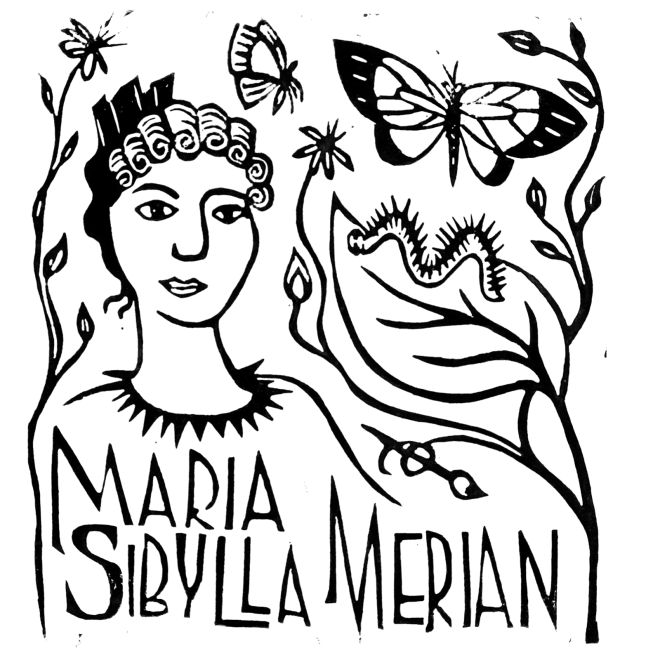
Maria Sibylla Merian was a naturalist who studied painted botanicals and insects. She was the first to fully record the metamorphosis of butterflies and portray animals in their natural context. In her fifties, she travelled to Suriname to portray the flora and fauna of the tropics.
Maria Sibylla Merian was already fascinated by the world of insects as a young girl, collecting specimens and raising silkworms by age 13. Her stepfather was a still-life painter and encouraged Maria to sketch, draw and paint, providing her with the skills for her detailed work.
She grew up near Frankfurt and, after her marriage, ended up in Nuremberg and Frankfurt-am-Main. She had two daughters. During her married life in Germany, she continued painting, created designs for embroidery and even gave drawing lessons to the unmarried daughters of wealthy families. These lessons provided an income but also gave her access to grand gardens to continue collecting and documenting insects. Maria used watercolours and gouache to paint her subjects because the guild system did not allow women to paint in oil.
I spent my time investigating insects. At the beginning, I started with silkworms in my home town of Frankfurt. I realized that other caterpillars produced beautiful butterflies or moths, and that silkworms did the same. This led me to collect all the caterpillars I could find in order to see how they changed.
Merian Sibylla Merian, foreword to Metamorphosis insectorum Surinamensium
But her marriage was an unhappy one. She left her husband, with her two daughters in tow, to join her brother who lived with a religious community in Friesland in the northern Netherlands. From there she eventually ended up in Amsterdam.
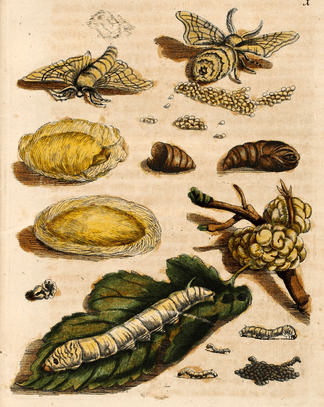
In Amsterdam, the capital of book printing, Merian published a two-volume series containing illustrations of the natural world, all engraved and etched by her, displayed in full colour. Though works like these were not uncommon, her skill and accuracy were. The series documents the process of metamorphosis of caterpillars and the plant hosts of 186 European insect species. Along with the illustrations Maria included descriptions of their life cycles.

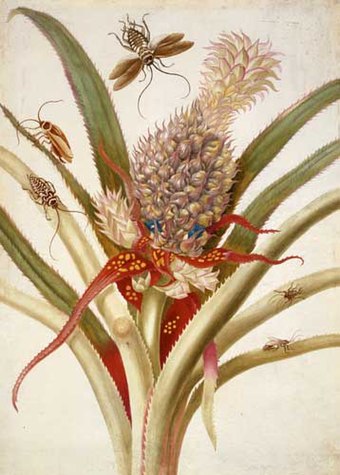
In 1699, at fifty-two, Maria set sail for the Dutch colony of Suriname. The plan was to go for five years and document whatever wonders of the insect and plant world they could find. Together with her youngest daughter, she would paddle upstream, into the tropical forest, and search for ‘new’ subjects – like pineapples.
Maria condemned the way slaves were treated by the colonisers. But someone forced an enslaved person to help Maria with her work. This did mean that Maria got to interact with the local and enslaved communities, helping her research into the plants and animals of Suriname. She also deplored the fact that merchants were not interested in any local crops, just sugar. “Indeed they mocked me for seeking anything other than sugar in the country.”
“You can certainly tell a Merian drawing. She has a deep affection for curls. I mean she can’t resist a curl.”
David Attenborough, interview on Living on Earth
Upon her return to Amsterdam, having left Suriname early due to health issues, she published Metamorphosis insectorum Surinamensium. The work influenced naturalist illustrators who came after her. Her work showcased new facts about insect life, included new details and is seen as a significant contribution to the field of entomology.
Maria reminds us that nature, science and the arts have a strong connection. She brought these fields together in her work and could be seen as the first ecologist, even though this word was not used during her time. Her contemporary, Antoni van Leeuwenhoek, brilliant as he was, did not possess the skills required to draw accurately. Members of the Royal Society with whom he corresponded asked him to look for an illustrator. He might have asked Maria – she would have been brilliant.
She ended her days running a little shop, selling the specimens she had collected across the Atlantic, together with the engravings she’d made of the Surinamese plant and animal life.
Others to discover
Another woman to read up on is Anna Botsford Comstock. From 1854 to 1930 she lived in New York, where she illustrated the natural world. She eventually became the first woman to be a professor at Cornell.
Sources and other media:
- Video: ‘The woman whose paintings changed science forever’, BBC Ideas’, https://www.bbc.co.uk/ideas/videos/the-woman-whose-paintings-changed-science-forever/p0c3tmh5
- Video: ‘The Story of Women and Art’, BBC Two, 2014: https://www.youtube.com/watch?v=DDP0qBpuDr0&ab_channel=RodneyMercer
- Book: ‘Good Night Stories for Rebel Girls’, Elena Favilli and Francesca Cavallo, 2017.
- Book: ‘Summer Birds: The Butterflies of Maria Merian’, Margarita Engle and Julie Paschkis, 2010.
- Book: ‘De Ontdekking van de natuur’, Hans Mulder, 2020.
- Podcast: Stuff You Missed in History Class: https://www.iheart.com/podcast/stuff-you-missed-in-history-cl-21124503/episode/maria-sibylla-merian-30207407/
- Podcast: ‘Dynamos: Maria Sibylla Merian’, Womanica, 2001: https://podcasts.apple.com/us/podcast/dynamos-maria-sibylla-merian/id1464524725?i=1000570448123

 Brain & Guts
One Comment
Comments are closed.