
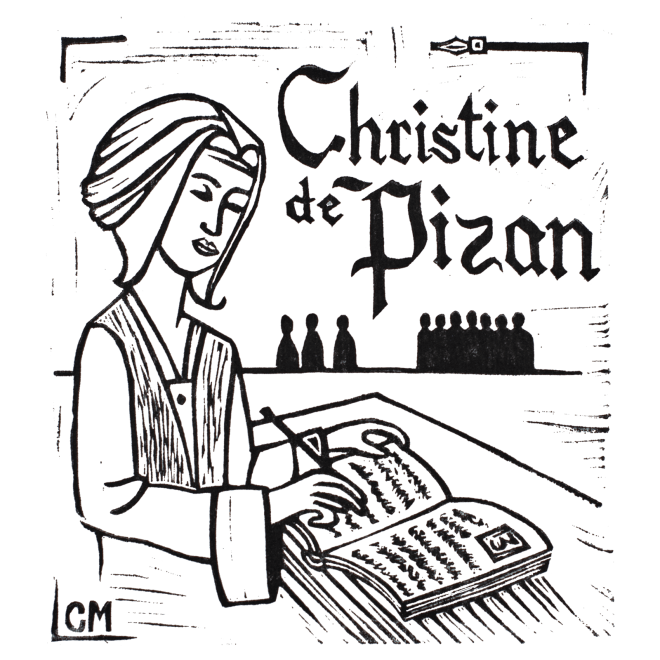
Christine de Pizan was a 14th-century author, moralist and political thinker. She wrote ‘La Cité des Dames’, a rebuttal against a popular misogynist novel of the time. In the book she ‘builds’ an allegorical city of ladies using the stories of different historical and mythical women as building blocks. She was also a great advocate of education for women.
Her most notable work is the book ‘La Cité des Dames’, or City of Ladies, written in 1405. It was a formal response to Jean de Meun’s popular, but misogynist, ‘Roman de la Rose’. In the book, she is accompanied by three daughters of God – Reason, Rectitude and Justice – as they create an allegorical city of ladies. By collecting a wide array of famous women throughout history, she builds her city, and thesis, using each famous woman as a building block. Each woman added to the city adds to her argument that women are valued participants in society. She also advocates in favour of education for women.
“For you know that any evil spoken of women so generally only hurts those who say it, not women themselves.”
Christine de Pizan, The Book of the City of Ladies
Born in Venice, she lived most of her life at the French court. At fifteen Christine married Etienne du Castel, with whom she had three children. He was a royal secretary and their marriage was a happy one. But their happiness was short-lived. Within just a few years Christine lost a son, her father, their protector King Charles V, and finally her husband. Suddenly, at 25, she was without male protectors and had to provide for the family. Surprisingly, in a time before the printing press, she chose writing to do so. This makes her one of the first western women with a professional literary career. Her patrons included dukes Louis I of Orleans, Philip the Bold, and John the Fearless. She wrote poems about courtly love, grief, a biography of Charles V of France and several works to defend women.
By employing female scribes, she confirmed their existence, gave work to women, and made certain that her words passed through women’s hands.
PS. Her method of building an allegorical city might be inspired by the ancient Roman orator Cicero. He used to memorise his speeches by imagining them as a building, with rooms as paragraphs and objects as specific points to make.
Sources and other media:
- Podcast: ‘Christine de Pizan: from medieval writer to feminist icon’, ep 1348, History Extra podcast, 2022: https://shows.acast.com/historyextra/episodes/christine-de-pizan-from-medieval-writer-to-feminist-icon
- Article: ‘Christine de Pizan, Place setting, The Dinner Party’, Judy Chicago, Brooklyn Museum, 1979: https://www.brooklynmuseum.org/eascfa/dinner_party/place_settings/christine_de_pisan
- Podcast: ‘Christine de Pizan and the Book of the City of Ladies’, Stuff You Missed in History Class, 2018: https://www.iheart.com/podcast/stuff-you-missed-in-history-cl-21124503/episode/christine-de-pizan-and-the-book-29805332/
- Podcast: ‘Beautiful Minds: Christine de Pizan’, Encyclopedia Womannica, 2019: https://encyclopedia-womannica.simplecast.com/episodes/beautiful-minds-christine-de-pizan-eV_aY36N
 Brain & Guts