

Judith was a 17th-century Dutch painter from Haarlem, The Netherlands, whose work features bold loose brushstrokes and intimate social scenes of jolly drinkers, children and musicians. Until the late 1800s, her work was attributed to Frans Hals, his brother Jan or her husband. Though highly regarded by contemporaries, her work was forgotten after her death. In the 19th-century, her work was rediscovered.


1. Company playing music and drinking in an interior, ca.1629;
2. The Last Drop, ca 1630;
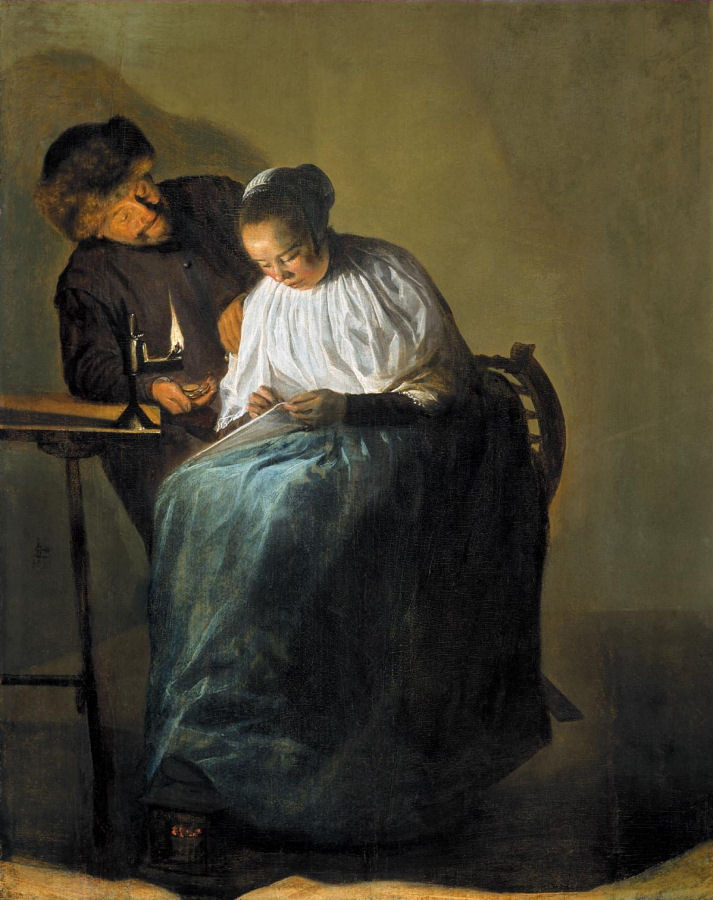
3. The Proposal, 1631.
Born in 1609 as the 8th of nine children, she was the daughter of Jan Willemsz. Leyster, a cloth maker from Antwerp and Trijn Jaspersdr. Her father bought a brewery called ‘Ley-star’, or pole star, that had a sign with that name above the door. This building was their home and was where Judith was born. This being before official surnames, Judith used ‘Leyster’ as her surname and as a monogram with a shooting star.
It’s unclear where she was trained and how, with her background, she got a chance to develop her skill. We do know that in 1633, at 24 years old, she became a member of the Haarlem Painters Guild of St.Luke. Her self-portrait is from this period and was likely painted for her entry to join the guild. She was allowed to establish her own workshop with pupils. From the documents it is clear Judith was an unmarried woman, running her own studio, educating students and employing staff.
Unlike Frans Hals, who was a contemporary working in the same city, her work plays with different lighting effects. She often painted smaller everyday scenes that feel intimate due to the indirect light sources. About 18 works have been attributed to her with certainty, including still life, a portrait of a woman, an aquarelle of a tulip and several social scenes. Most of these were from before her marriage. She likely painted for the market, not on assignment, so her scenes were likely her own invention. The work shown above on the right, “The Proposal”, shows the scene of a man proposing something to a woman who is resolutely keeping her eye on her work. Is there a message in there?

1. Self-portrait, 1633;
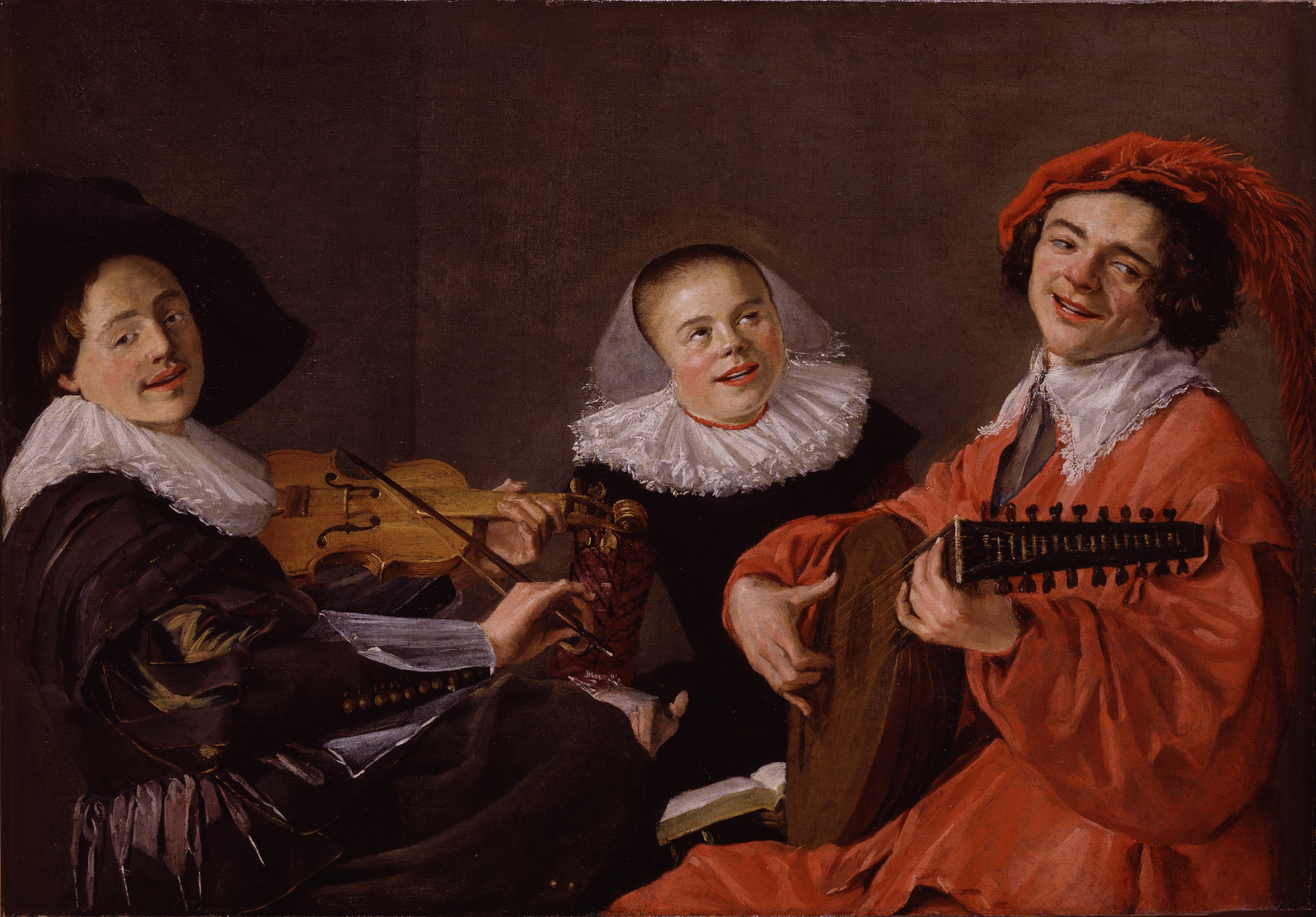
2. The Concert, ca1633.
Sadly, when Judith married fellow artist Jan Miense Molenaer in 1636, her independent career pretty much ended. She likely had to focus on the care for her children. The pair had likely already known each other for years, and maybe even worked together. The lived in both Amsterdam and Haarlem and seemed to have been quite well off. The couple invested in property, partially paid for by paintings, and when Judith is mentioned in documentation she is referred to as an agent or accountant. Though difficult to prove, it is probable, that Judith continued painting under her husband’s atelier instead. She was very versatile and talented, after all.
Though well respected during her time, her work was largely forgotten after her death. This might have been due to her signing with a monogram, the meaning of which was likely forgotten. It was only in 1892 when a work ascribed to Frans Hals was questioned during a sale, that Judith was rediscovered. She got a solo exhibition at the Frans Hals Museum in Haarlem in 1993, followed by the Worchester Museum of Art in Worchester, Massachusetts. Her work can be seen in the Rijksmuseum in Amsterdam, the Mauritshuis, The Hague, Frans Hals Museum, Haarlem, the Louvre in Paris, the National Gallery in London and the National Gallery of Art, Washington DC.
In 2016 a self-portrait of an older Judith was discovered. Judith Leyster is now largely recognised as one of the masters of the Dutch 17th century.
Also look up:
Whilst Judith was a stand-out painter in The Netherlands, her contemporary Artemesia Gentileschi was one of the most accomplished 17th-century painters coming out of Italy. She led a colourful life, but produced even more colourful impressive works of art. Her self-portrait, ‘Susanna and the Elders’ and her versions of the story of the biblical Judith are worth a look.
Judith was likely the first woman member of Haarlem Guild of St. Luke, trade organistion for painters, but there is a chance it was fellow artist Sara van Baalbergen.
Sources and other media:
- Book: ‘1001 vrouwen uit de Nederlandse geschiedenis’, red. Els Kloek. Amsterdam: Uitgeverij Vantilt, 2013. p. 349-351.
- Article: ‘7 Amazing Facts About Judith Leyster, A 17th -century talent lost and found’, Rebecca Appel, Google Arts&Culture: https://artsandculture.google.com/story/DQIChb-z8As2Jg
- Slideshow: Judith Leyster, 1609 – 1660′, National Gallery of Art: https://www.nga.gov/features/slideshows/judith-leyster.html
- Article: ‘Judith Leyster, 1609 – 1660’, Els Kloek, Huygens ING, 2014: http://resources.huygens.knaw.nl/bwn1780-1830/DVN/lemmata/data/Leyster
- Article: ‘Judith Leyster (1609-1660) – Beroemdste schilderes uit de Gouden Eeuw, Een vrouwelijke meesterschilder’, Historiek, 2019: https://historiek.net/judith-leyster-kunstenares-gouden-eeuw/74367/
 Brain & Guts