

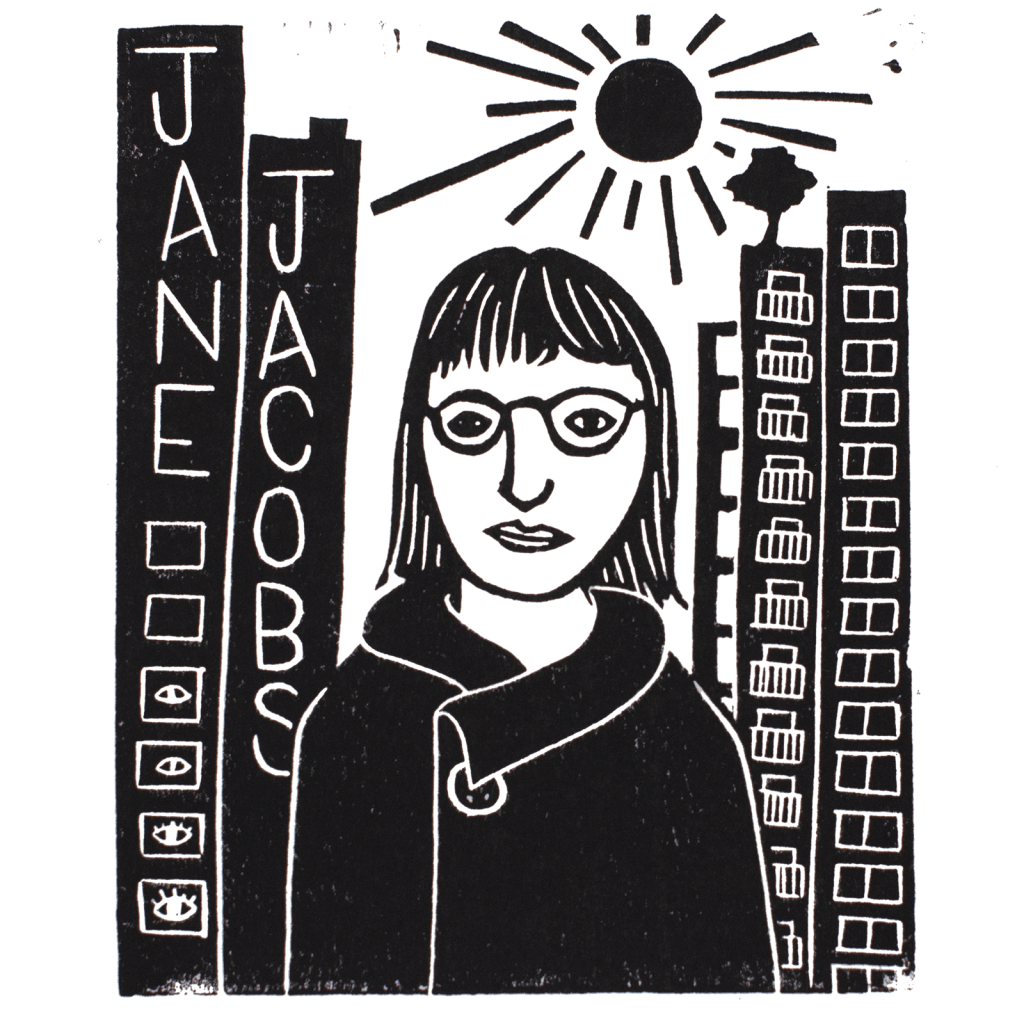
Jane a writer and activist, known for her commentaries on urban development. Though put down by some as a housewife, her writing and grassroots activism in the male-dominated field of urban planning achieved great success in her hometowns of New York City and Toronto and her theories on city neighbourhoods continue to be influential.
are we building cities for people or for cars?
Jane Jacobs
Her critique of post-war rationalist and modernist thinkers, like Le Corbusier, was that they oversimplified the complexity of human nature and the reality of diverse urban communities. A neighbourhood is made up of family-owned shops, elderly men on rocking chairs and mothers walking with children. She felt that city planners were often out of touch with that experience. She brought an empathy to city planning.
Instead of slapping an expressway right through the middle of a city, she wanted planners to consider the community they were breaking up by doing that. A frequent question of hers was: are we building cities for people or for cars? Plans should at the very least be informed by what is on the ground. Her contributions to the opposition of rigorous redevelopments in New York City and Toronto were successful.
“Cities have the capability of providing something for everybody, only because, and only when, they are created by everybody.”
Jane Jacobs, The Death and Life of Great American Cities, 1961
The sidewalk was an example she liked, comparing it to an “intricate ballet” of strangers “in which the individual dancers and ensembles all have distinctive parts which miraculously reinforce each other and compose an orderly whole.” She called this organic dynamism, a complex network of people and interactions – which is difficult to pin down with a rigid top-down plan. The sidewalk also maintains public order, with pedestrians facilitating contact and functioning as “eyes on the street”.
A telling anecdote is of a young Jane, in grade-school, staging a rebellion against a pledge to brush your teeth — she wasn’t against the brushing, just the coerced promise — which led to her being briefly expelled. Standing up to authority started young.
Jane was indeed a housewife without a college degree, with three children and eventually grandchildren, but this did not diminish her drive, critical thinking, understanding of the reality of ‘urban dwellers’ and her influence on her immediate local context and philosophy on the shared spaces of our societies in general.
Sources and other media:
- Article: ‘Jane Jacobs’s Street Smarts’, Adam Gopnik, The New Yorker, 2016: https://www.newyorker.com/magazine/2016/09/26/jane-jacobs-street-smarts
- Book: ‘The Death and Life of Great American Cities’, Jane Jacobs, 1961.
- Picture book: ‘Walking in the City with Jane: A Story of Jane Jacobs’, Susan Hughes, 2018.
- Video: ‘American Masters, Jane Jacobs vs Robert Moses: Urban Fight of the Century’, PBS, 60s: https://www.youtube.com/watch?v=TMnUnp0ifgo
 Brain & Guts