
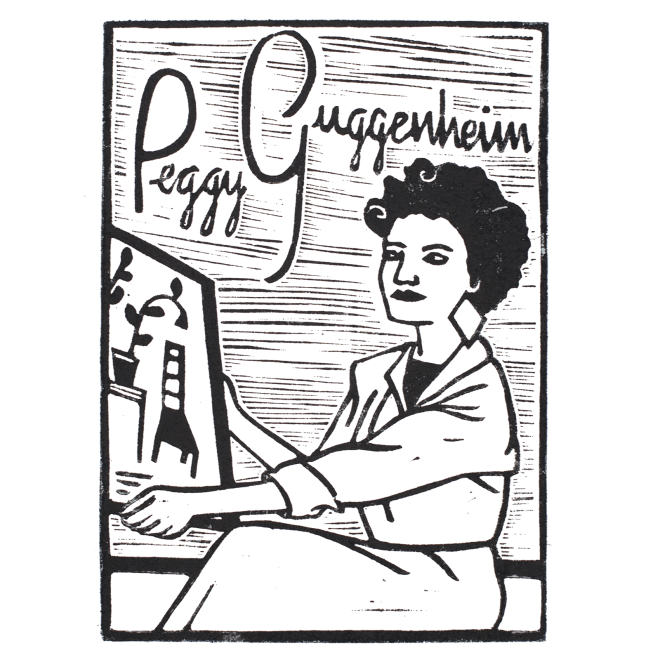
This eccentric lady led a colourful life and changed the art world while she was at it. Her art collection, gallery in Venice and her role in championing artists like Jackson Pollock changed modern art forever. Her friends were famous, her style eccentric and her influence great.
As a result of her father’s premature death aboard the Titanic’s maiden voyage, Peggy inherited her grandfather’s fortune at the early age of 21. When travelling to Paris with her mother, Peggy met and married the French writer Laurence Vail. He introduces her to Parisian artists and future friends, like Marcel Duchamp and Constantin Brancusi, who guide her through the art world. She slowly gets a feel for what is the cream of the modern art crop.
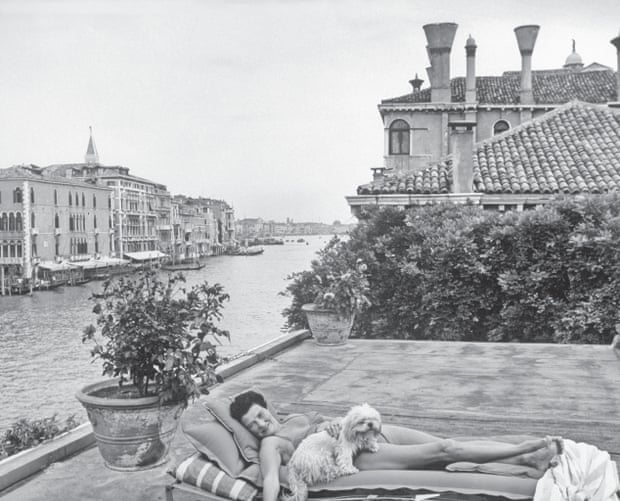
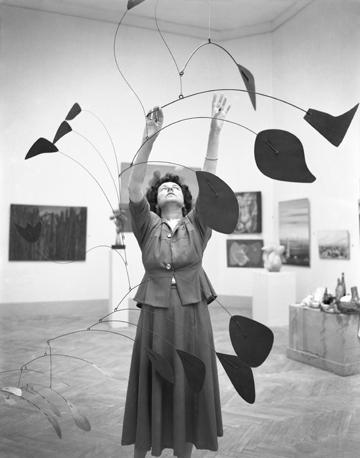
Her choices affected the course of twentieth-century art history
Mary V. Dearborn, one of Peggy’s biographers
She divorced Vial and in 1939 Peggy opened art galleries in London and Paris, following her uncle Solomon R. Guggenheim’s example, known from the Guggenheim Museum in New York. Peggy’s collection included works by the likes of Picasso, Dalí and Braque. During the Second World War, she shipped her collection across the Atlantic for safekeeping, labelled as ‘household items’ and with a less Jewish sounding name. In New York, where she married artist Max Ernst, she showcased her collection and continued to collect art. Her ‘discovery’ of the abstract artist Jackson Pollock was, according to herself, one of her greatest achievements.
After her marriage to Max Ernst ended, Peggy decided to reinvent herself in Venice. She found a one-story palazzo, previously owned by two other extravagant single ladies. After a rigorous refurbishment of the palazzo, she started a permanent museum, the “Peggy Guggenheim Collection”, which still exists today. It was unusual, with her house and the museum in one space.
I dedicated myself to my collection. A collection means hard work. It was what I wanted to do and I made it my life’s work. I am not an art collector. I am a museum.
Peggy Guggenheim, Peggy Guggenheim and Her Friends, 1970-76
The collection housed there included 326 paintings and sculptures with work by Pablo Picasso, Jackson Pollock, Constantin Brancusi, Joan Miró, Alexander Calder, Salvador Dalí, Willem de Kooning, Mark Rothko, Alberto Giacometti, Wassily Kandinsky, and Marcel Duchamp.
Her gallery was often “belittled as a rich woman’s vanity project” and she faces sexism and antisemitism. But she didn’t let it stop her. It seemed she wasn’t too concerned with what people thought. She had numerous affairs, her lovers included Samuel Beckett, Yves Tanguy, Marcel Duchamp, and she remained “uninhibitedly sexual in middle age”. When asked how many husbands she had had, she once replied, “You mean my own, or other people’s?”
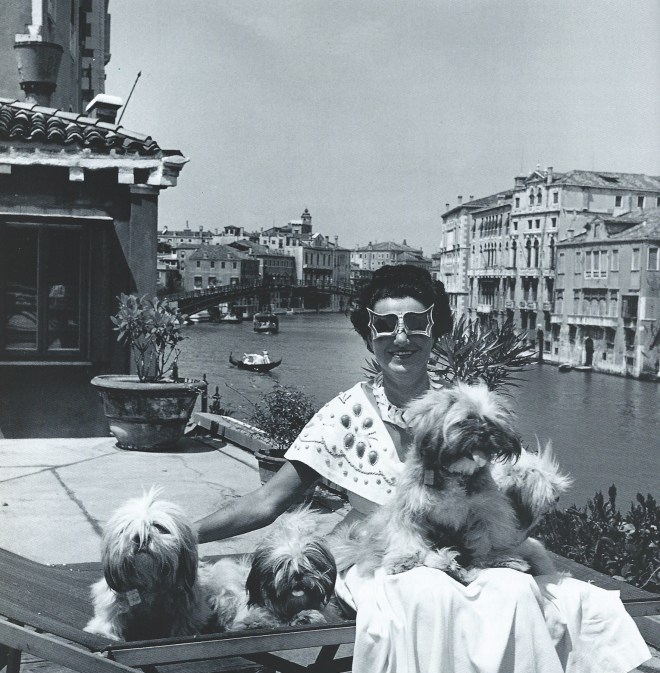
Both her friends and those who fought for social progress could count on her generosity. Surprisingly, she’s also said to be stingy. Refolding used napkins for the next guest. Her personality, sometimes seen floating around the Venice canals with her dogs on her own boat, was often the cause for media attention. As one critic put it, “even her sunglasses made news.”
Her collection and museum, now owned by her uncle’s foundation and still at the centre of a years-long legal battle, can still be seen.
ALSO LOOK UP
In Europe, it was Helene Kröller-Müller, a German art collector, who is known to be the first European women to put together a major art collection. She is supposed to have spotted Vincent van Gogh’s genius first.
Sources and other media:
- Article: ‘Sex and art by the Grand Canal: how Peggy Guggenheim took Venice’, Judith Mackrell, The Guardian, 2017: https://www.theguardian.com/artanddesign/2017/may/09/sex-and-art-by-the-grand-canal-how-peggy-guggenheim-took-venice
- Article: ‘About Peggy’, Peggy Guggenheim Collection: https://www.guggenheim-venice.it/en/art/in-depth/peggy-guggenheim/about-peggy/
- Article: ‘5 Priceless Facts About the Avant-Garde Art Collector Peggy Guggenheim’, Kelly Richman-Abdou, My Modern Met, 2020: https://mymodernmet.com/peggy-guggenheim-facts/

 Brain & Guts