
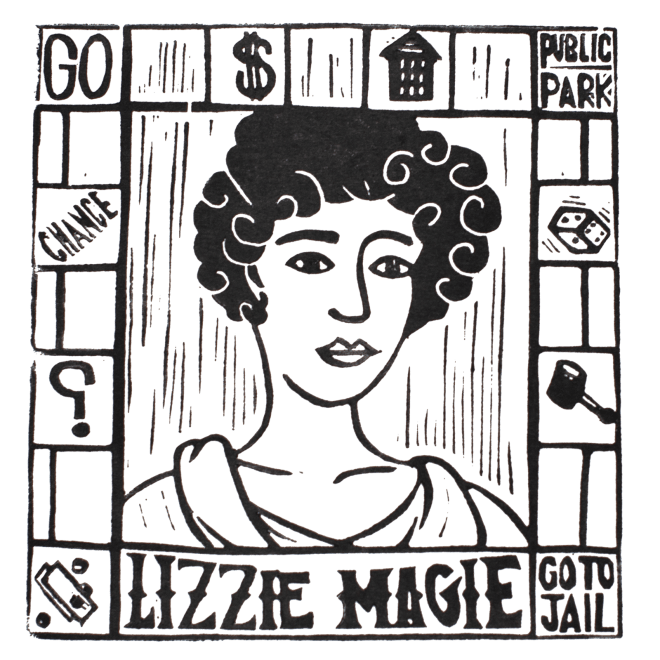
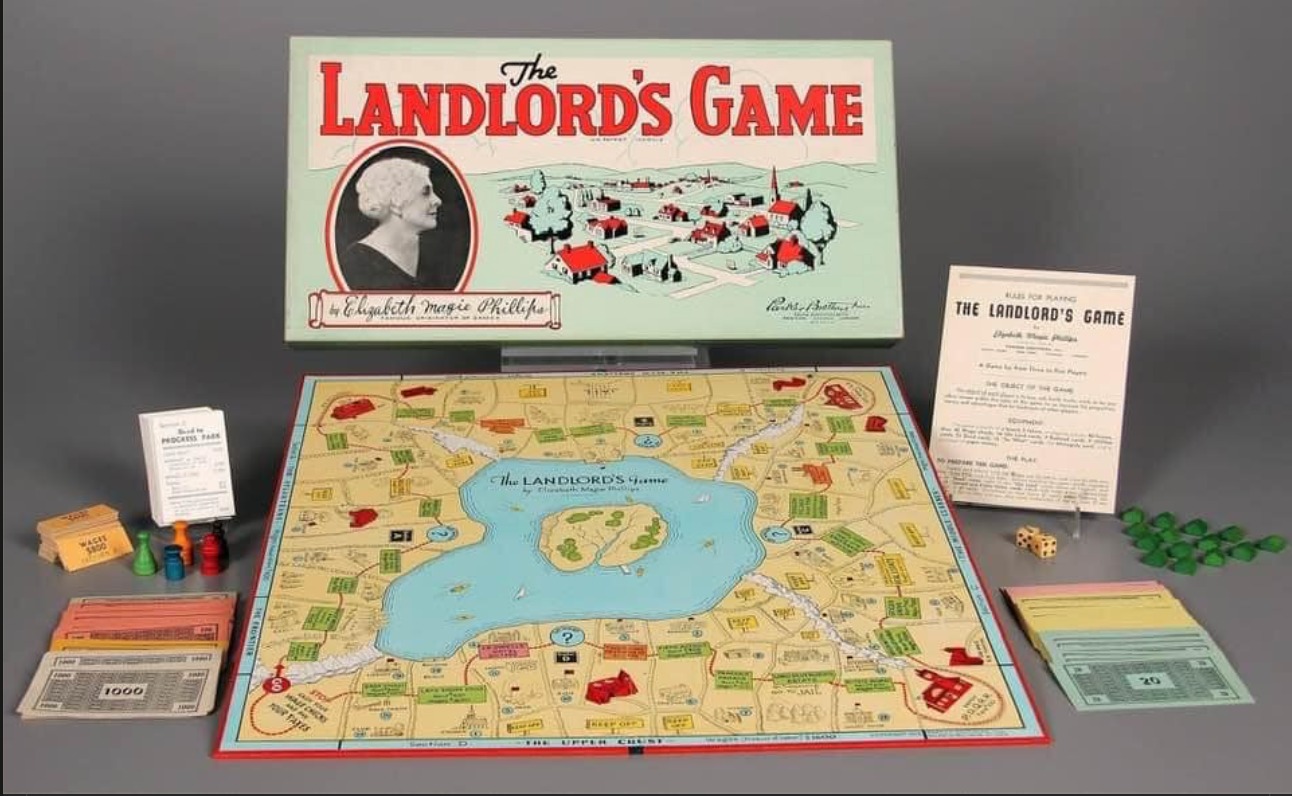
Elizabeth Magie, called Lizzie by her friends, was the inventor of The Landlord’s Game, a version of what we now call Monopoly. She also had strong opinions on the role of women in society, causing a stir with an ad in the newspaper to auction herself off for marriage.
Lizzie’s game was not meant to be one in which a single player slowly accumulates incredible wealth whilst the others suffer a painful crushing defeat. It was actually a practical demonstration against a “system of land-grabbing with all its usual outcomes and consequences”. She was a Georgist, a follower of the politician and economist Henry George, who believed in a single tax system in which people should be able to keep what they made or created but be taxed on land. Georgists believed that everything found in nature, particularly land, should belong to everyone.
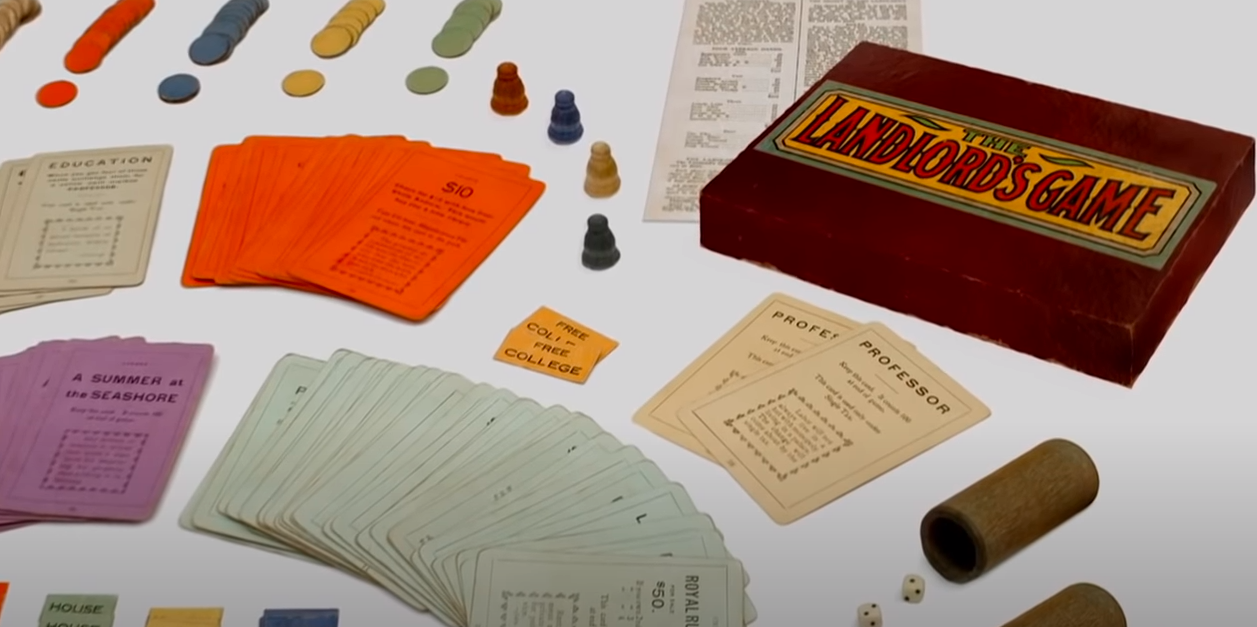
In her free time, Lizzie designed her game with the intent to spread George’s theory. The game provided two modes of play: monopolist and single tax. After playing both sets you should have been convinced that the single tax option, where everyone gains if a player lands on a square, is morally superior. Ironically, it turned out that people enjoy crushing their opponents and hoarding fake board game money, especially during the Great Depression. So in the end, the monopolist version of the game won out.
Lizzie patented her game in 1903 (on the same day the Wright brothers filed theirs). As a woman, then in her 30s, she belonged to less than 1% of all patent applicants.
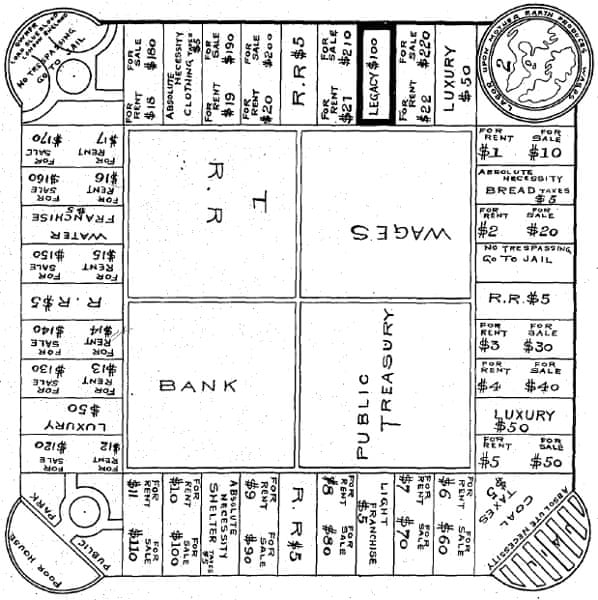
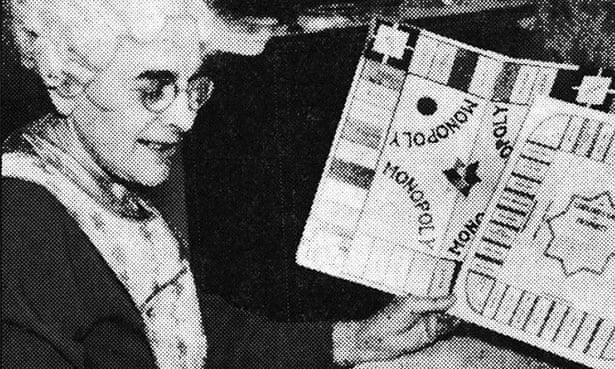
Though Lizzie’s game was patented, it was not protected, because it got copied throughout left-wing communities in Northeast USA and schools like Yale and Harvard. People started adding local street names, colours and other personalisations. Then, in the 1930s, a man called Charles Darrow came across the game at a friend’s house and started selling homemade copies. He then sold the concept to The Parker Brothers, a game company that had previously declined to work with Lizzie Magie.
Together, The Parker Brothers and Charles Darrow crafted a new story. Their rebranded Monopoly game conveniently obscured Lizzie Magie’s story and instead told one of a man who went from being unemployed to becoming a millionaire and who saved himself and the publishing company from ruin. Sadly, this was not the first time a woman was deliberately written out of the story for convenience.
“I have often been called a ‘chip off the old block, which I consider quite a compliment, for I am proud of my father for being the kind of an ‘old block’ that he is.”
Lizzie Magie about her father James Magie for his reputation as a rousing speaker
Lizzie Magie was born in 1866. Her father, James Magie, was a newspaper publisher and abolitionist who accompanied Lincoln as he travelled around Illinois in the late 1850s. This meant that Lizzie was exposed to politics from a young age.
Lizzie was an independent and unusual woman. Apart from working as a stenographer and secretary, she also wrote poetry and short stories and performed comedic routines. Apparently, she could be very funny on stage. She was the head of her own household and saved up to buy her house. Though she did finally marry at the grand ‘old’ age of 44, she had previously made the national news for a stunt mocking marriage. To illustrate how difficult it was for an unmarried woman to support herself on $10 (even with a patent in the pocket) she put herself up for auction. The ad in the paper offered her up herself to the highest bidder: a “young woman American slave”, “not beautiful, but very attractive” with “features full of character and strength, yet truly feminine.” Her stunt commented both on the position of women in society and the US history of slavery.
“We are not machines…Girls have minds, desires, hopes and ambition.”
Lizzie when interviewed by newspapers about her auction stunt.
In 1948, Magie died without any recognition for her role in the development of the world-famous game of Monopoly. She was actively omitted from the record, which you wonder what other inventors we have yet to find out about!
Sources and other media:
- Article: Monopoly’s Inventor: The Progressive Who Didn’t Pass ‘Go’, Mary Pilon, The New York Times, 2015: https://www.nytimes.com/2015/02/15/business/behind-monopoly-an-inventor-who-didnt-pass-go.html
- Article: ‘The secret history of Monopoly: the capitalist board game’s leftwing origins’, Mary Pilon, The Guardian, 2015: https://www.theguardian.com/lifeandstyle/2015/apr/11/secret-history-monopoly-capitalist-game-leftwing-origins
- Podcast: ‘The Landlord’s Game’, 99% Invisible, 2015: https://99percentinvisible.org/episode/the-landlords-game/
 Brain & Guts