
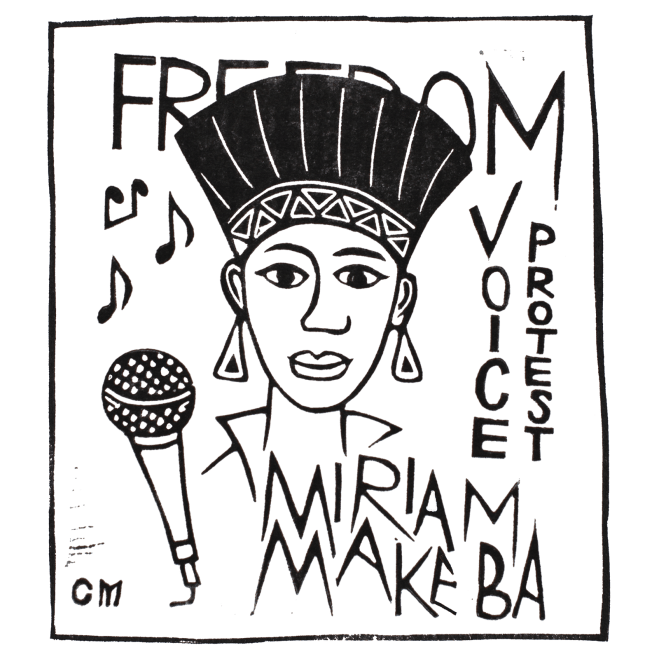
Miriam was a singer and activist from South Africa. Sometimes nicknamed ‘Mama Africa’, she was one of the first African artists to become celebrated in ‘the west’ and was internationally known as a vocal activist against South Africa’s apartheid regime.
We as artists should never close our eyes to what is happening around us.
Miriam Makeba, 1969.
In 1948, when apartheid was introduced in South Africa, Miriam was old enough to realise what that meant. An all-white authoritarian government-enforced their racism in codified law and restricted the rights of all non-white citizens.
Miriam’s first marriage (out of five) was at 17, which was when she also gave birth to her daughter Bongi. It was a tumultuous time, as she was diagnosed with breast cancer and treated successfully by her mother, a traditional healer. Her husbands left her shortly after.
During the fifties, Miriam lived in Grahamstown, a town where people mingled and different genres of music influenced each other. She sang with different bands in several genres. Her role in the musical ‘King Kong’ brought Miriam recognition in South Africa and a small role in the 1959 film ‘Come Back Africa’ got her noticed internationally. In search of opportunity, Miriam left the country, the first of many black musicians to leave South Africa due to apartheid. When she wanted to return for her mother’s funeral, she found the government did not allow her back in. She would not return to South Africa for decades.
With a stopover in London, Miriam moved to New York City and recorded her first of several solo albums. In the US, her international career took off. She got a Grammy for the album she made with her friend Harry Belafonte, performed for JFK in Madison Square Gardens and her song Pata Pata made her the first black woman with a worldwide Top 10 hit.
I kept my culture. I kept the music of my roots. Through my music I became this voice and image of Africa and the people without even realising
Miriam Makeba, from her biography from 2004.
While her career flourished in the US, her activism increased. She testified twice against the South African government at the United Nations and got involved in USA civil rights, marrying Black Panther civil rights activist Stokely Carmichael. Her involvement with the civil rights movement and her vocal stance against the apartheid regime took away from her appeal to US white audiences. When even the US government started showing hostility, the couple moved to Guinea in West Africa.
I see other black women imitate my style, which is no style at all, but just letting our hair be itself. They call it the Afro Look.
Miriam Makeba, on people imitating her ‘look’
From Guinea, Miriam started touring the African and European continents and continued recording. From there she released more explicitly critical songs about apartheid, like ‘Soweto Blues’, written by her former husband and musician Hugh Masekela. The song was about the Soweto Uprisings, in which black schoolchildren protested against schooling in Afrikaans (a symbol of the apartheid regime). Within 72 house hundreds of children were shot and killed. This uprising was also the topic of the film Sarafina, in which Miriam featured in 1992.
The eighties were a tough time for Miriam, as she separated from her husband, lost her daughter in tragic circumstances, had difficulties with alcohol abuse and had to overcome cervical cancer. In 1987 she returned to the international stage, having joined Paul Simon’s successful Graceland tour.
She was the ‘mother of our struggle’ and ‘South Africa’s first lady of song’… Her music inspired a powerful sense of hope in all of us. Even after she returned home she continued to use her name to make a difference by mentoring musicians and supporting struggling young women.
Nelson Mandela, 2008.
In 1990, as the apartheid regime was forced to give way to a new government with Nelson Mandela, Miriam returned to her country of birth. There she continued to record and perform, supported several charities and became a UN Goodwill Ambassador for South Africa.
Miriam Makeba’s legacy is not just musical, bringing Afropop and African jazz to a broader audience, but also one of continued activism.
Sources and other media:
- Podcast: ‘Pioneers: Miriam Makeba’, Encyclopedia Womannica’, 2019: https://encyclopedia-womannica.simplecast.com/episodes/pioneers-miriam-makeba-gc81ZttC.
- Article: ‘Mandela mourns icon Miriam Makeba’, BBC News, 2008: http://news.bbc.co.uk/2/hi/africa/7719927.stm#:~:text=richly%20deserved%20the%20title%20of,women%2C%22%20Mr%20Mandela%20said.
- Article: ‘Miriam Makeba’, Graeme Ewens, The Guardian, 2008: https://www.theguardian.com/music/2008/nov/11/miriam-makeba-obituary
- Article: ‘Miriam Makeba’, South African History Online, 2011: https://www.sahistory.org.za/people/miriam-makeba
- Video: ‘Interview with Miriam Makeba in 1969’:

 Brain & Guts