

“I was bought as a butcher would a calf or a lamb”. Those are Mary Prince’s words, published in the 1831 book ‘The History of Mary Prince, a West Indian Slave, Related by Herself’. It was a first-hand account of the events of her life in slavery. She wanted to ensure that the “good people in England might hear from a slave what a slave had felt and suffered,” explained her editor, the abolitionist Thomas Pringle. Mary was the first Black woman in Britain to publish an account of her life and the first woman to petition the British Parliament. Her story was so brutal that many would not believe it at first, but the brave sharing of her story contributed to the eventual abolition of slavery.
Mothers could only weep and mourn over their children, they could not save them from cruel masters – from the whip, the rope, and the cow-skin
Mary Prince describing the system in which she grew up
Mary was born in Bermuda in 1788. Up until the age of 12, she and her siblings were raised by a loving mother. Her mother worked in the Williams family household, where Mary, so she writes, “was made quite a pet of by Miss Betsey [the Williams’s child, who] used to lead me about by the hand, and call me her little nigger”. The first tragedy struck when the family’s fortunes changed and Mary’s mother was forced to sell her daughter at the market, where, she “was soon surrounded by strange men, who examined and handled me in the same manner that a butcher would a calf or a lamb he was about to purchase”. She would never see her mother or sisters again.
[They bought me] as a butcher would a calf or a lamb
Mary Prince
For the next 15 years, Mary was passed between owners, “from one butcher to another”, on different Caribbean Islands. Mary relays in her book how these men abused her in many different ways. In 1815, she was bought by John Wood; a man with a mean streak. The Wood family took Mary to Antigua, where she met Daniel James, a carpenter who had bought his own freedom. The two married in December 1826, without permission, for which Mary was whipped and locked up as punishment.
Mary was a hard worker. She suffered from rheumatism for months on end, a condition for which she was also often punished. The Wood family would lock her in a cage, beat her, and at times leave her for dead. Despite this treatment, the Wood family refused any requests from her husband to buy Mary’s freedom. It seems they wanted to keep this hardworker on, as an option.
In 1828 the Wood family left for London, taking Mary with them. Mary hoped it would be a chance for her rheumatism to improve and that she might be able to return a free woman (because slavery was not allowed in the UK itself). But both of these aspirations fell through pretty quickly. As soon as they arrived in London, Mary’s joints seized up and she was unable to do the washing. Mrs Wood beat Mary in anger; Mary ran away within a year. She ended up at the London Anti-Slavery Society, where she learned that, although free in London, she could only return to her beloved husband as property of the Wood family.
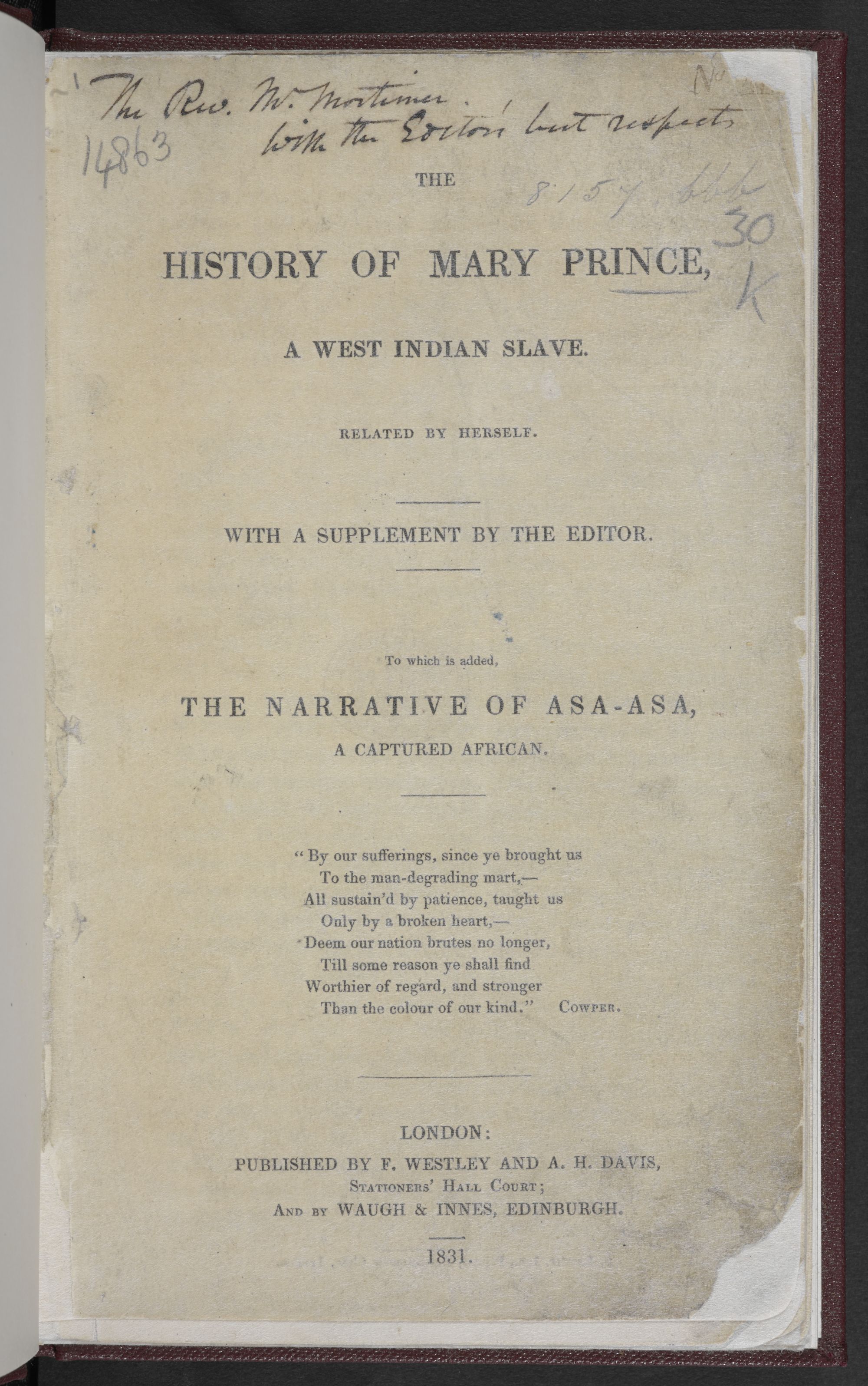
In 1829, on June 24th, Mary petitioned for her freedom at the British Parliament, the first woman to ever do so. Sadly, it was unsuccessful. That’s when Mary decided to work with abolitionists Thomas Pringle and Susana Strickland to get her life story published: ‘The History of Mary Prince’.
As of the year 1800, some 450,000 enslaved workers from the British West Indies were supporting the British economy. The abolishment of slavery happened in multiple steps and over decades. Legislation finally freed enslaved workers, the result of continued and intense campaigning from many different people and groups, including the enslaved themselves. According to the Museum of London Docklands, Mary’s account “played a crucial role in the abolition campaign.” Her story gave the public an example of the impact of slavery on the life of an individual.
Many 18th-century Brits were unaware of the atrocities happening in their West-Indies; Mary’s account was one of their first confrontations with this reality. Some readers could not believe the brutality she described, thinking it was too extreme to be accurate. Mrs Pringle, wife of Mary’s editor, wrote to the Birmingham Ladies Society for the Relief of Negro Slaves to confirm the story after it had been questioned. Mrs Pringle recounted that she had examined Mary and the “whole of the back part of her body is distinctively scarred… chequered with the vestiges of severe floggings”.
extraordinary symbol of tenacity and resilience
Jak Beula, founder of Nubian Jak and organiser of the Mary Prince plaque in Bloomsbury
Mary’s narrative, though shocking, now tends to be regarded as historical record, rather than as an individual’s story. Gretchen Gerzina, author of ‘Black London’, explained that “as far as slave narratives go, it is a familiar story.” What’s unusual is that it comes from a Black woman. Regardless of how familiar that story has become, it was brave of Mary to share it. According to Mr. Pringle: “The idea of writing Mary Prince’s History was first suggested by herself”.
Mary’s determination to tell her story is often misrepresented. She’s been portrayed as a passive, uneducated woman who was simply used as a tool by the Abolitionist movement. But that’s not fair to Mary. Sarah Salih, editor of the most recent edition of the book, did further research and concluded that “far from passively accepting the punishments meted out to her, Mary Prince protested against her treatment at every available opportunity. Her history is a culmination of this protest”.
Unfortunately, we know very little about what happened to Mary after the publication of her history. Did she ever see her beloved husband again?
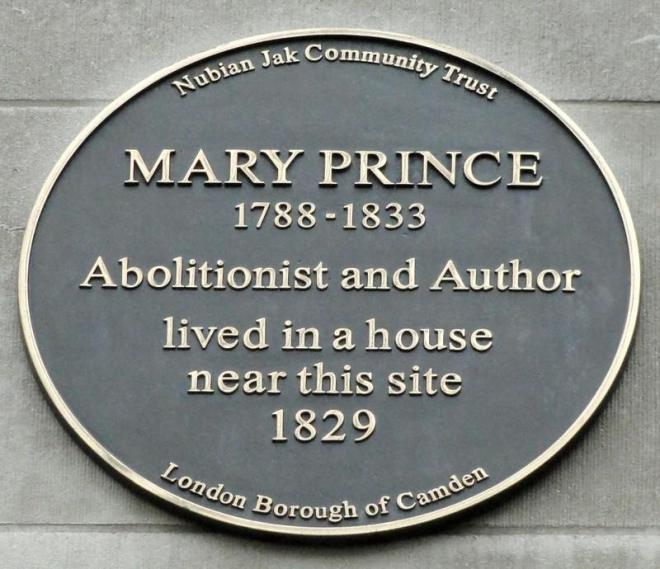
Commemorative plaque at Senate House, University of London. Mary Prince lived on the site in 1829. It was unveiled in 2007 by the Nubian Jak Community Trust, recognising Mary’s contribution to ending slavery.
Also look up
Elizabeth Freeman, was the first African-American in the US to seek legal action against the abuse of slavery. She won. Anne Julia Haywood Cooper was a US author, sociologist and educator. Her book ‘A Voice from the South: By a black woman from the South’, won her the nickname ‘Mother of Black Feminism’. Sarah Parker Redmond is also worth a look-up. There was a 2006 book called ‘Far More Terrible for Women: Personal Accounts of Women in Slavery (Real Voices, Real History)’, arguing that firsthand accounts from women are hardly ever heard.
Sources and other media
- Text transcribed by Apex Data Services, Inc., LeeAnn Morawski and Natalia Smith, 2000: https://docsouth.unc.edu/neh/prince/prince.html
- Website: https://www.maryprince.org/
- ‘They bought me as a butcher would a calf or a lamb’, Sara Wajid, The Guardian, 2007: https://www.theguardian.com/uk/2007/oct/19/race.historybooks
- ‘The History of Mary Prince’, British Library: https://www.bl.uk/collection-items/the-history-of-mary-prince-a-west-indian-slave
- ‘Forgotten Africans in Britain’s History – Part 3’, Affable Curmudgeon blog, 2019: https://kemet36.wordpress.com/2019/04/13/forgotten-africans-in-britains-history-part-3/
 Brain & Guts