
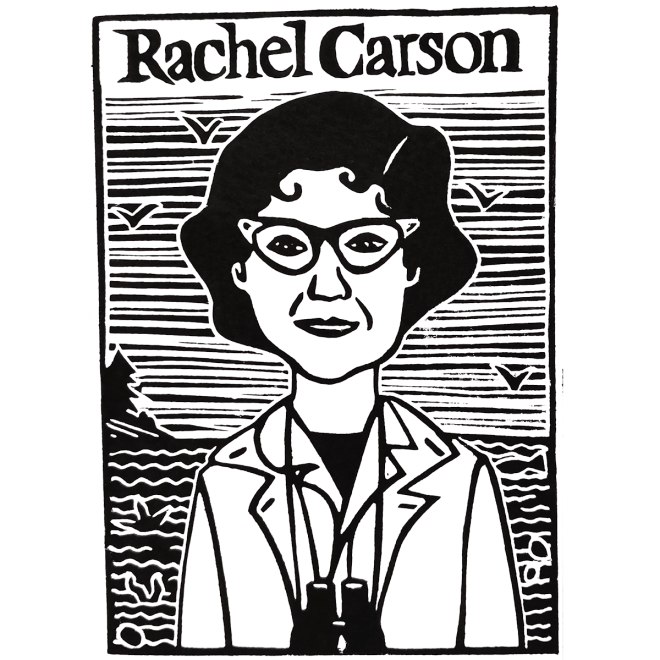
“We spray our elms and the following springs are silent of robin song, not because we sprayed the robins directly but because the poison travelled, step by step, through the now familiar elm-leaf-earthworm cycle. These are matters of record, observable, part of the visible world around us. They reflect the web of life—or death—that scientists know as ecology.”
Rachel Carson, Silent Spring, 1962.
Rachel was a marine biologist and scientific storyteller, whose poetic language opened the eyes of the western world to its environmental destruction. Her book ‘Silent Spring’ kickstarted the environmental movement, leading to a ban on the pesticides like DDT, the adoption of several environmental acts and to the founding of organisations like Greenpeace. She recognised the connectedness of our world – a reality she already described in the 1960s, but one we’re seemingly still coming to terms with. Her next book would have been on the “age of rising seas,” had she not fallen ill. “In our own lifetime, we are witnessing a startling alteration of the climate.” It’s time to catch up with Rachel.
The book ‘Silent Spring’, which notes the lack of birds in spring that decade, underlines the need for respect for ecosystems. Each element is part of a delicate balance and by introducing pesticides, humans can upset that balance. Her understanding of this delicate balance, of respect for life and death, cannot be seen as separate from her life. She spent much of it caring for her family members, including her mother (who typed up all her work and who died the year before Rachel’s famous book came out). “Wildlife, it is pointed out, is dwindling because its home is being destroyed,” she wrote in 1938, “but the home of the wildlife is also our home.” To her, her home life and the outside world were connected.
She was also a keen writer and lover of poetry. In fact, some of her work was turned away for being “too poetic”, skirting that line between science and poetry. But when she did get published it was precisely that language that drew people in and conveyed her passion for the ocean and the environment at large. Her editor said she was: “the stonemason who never lost sight of the cathedral.”
“Neither you nor I, with our earth-bound senses, know the foam and surge of the tide that beats over the crab hiding under the seaweed of his tide-pool home; or the lilt of the long, slow swells of mid-ocean, where shoals of wandering fish prey and are preyed upon, and the dolphin breaks the waves to breathe the upper atmosphere.”
Taken from Undersea by Rachel Carson, The Atlantic, 1937.
Her work took guts. With Silent Spring, for example, she took aim at the big players: the chemical industry. Not surprisingly, with a lot of money at stake, the chemical companies began a smear campaign against her. So often the case with women who take a stand.
Also look up:
Another woman who wasn’t afraid to go against the grain for the sake of the environment was Wangari Maathai, also on Brain & Guts. The women that have made a difference for our environment include Esther Boserup, Bina Agarwal, Carolyn Merchant and Vandana Shiva.
SOURCES AND Other media:
- Jill Lepore, ‘The right way to remember Rachel Carson’, The New Yorker, March 26, 2018: https://www.newyorker.com/magazine/2018/03/26/the-right-way-to-remember-rachel-carson
- ‘Rachel Carson Biography’, US Fish & Wildlife Service, 5 feb. 2013: https://www.fws.gov/refuge/Rachel_Carson/about/rachelcarson.html
- Robin McKie, ‘Rachel Carson and the legacy of Silent Spring’, The Guardian, 27 May 2012: https://www.theguardian.com/science/2012/may/27/rachel-carson-silent-spring-anniversary
- What the world can learn from Rachel Carson as we fight for our planet. https://www.theguardian.com/commentisfree/2021/oct/27/what-the-world-can-learn-from-rachel-carson-as-we-fight-for-our-planet?
 Brain & Guts