
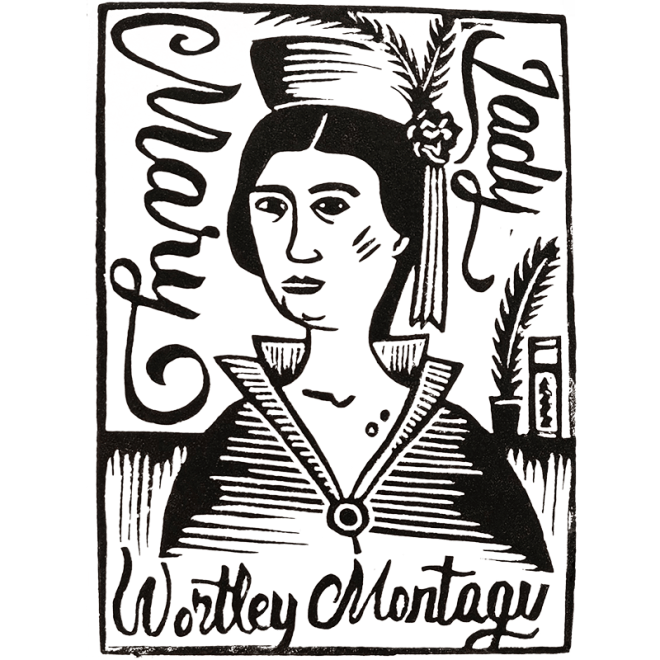
Lady Mary Wortley Montagu once wrote: “I am going to write a history so uncommon”. And so she did. She was one of the first western women to write about the Middle East, a supporter of women’s rights and brought the practice of inoculation to Britain (and the west).
The oldest child of a Duke, Mary got her education from her father’s library. She loved to read: “No entertainment is so cheap as reading, nor any pleasure so lasting.” She wrote poems, was pretty and witty, popular but very opinionated. As a young woman, however, she got smallpox, which left her scarred and weakened. Her brother died from the disease – killing one in four – but she survived. She eloped with a different man than the one her father had picked out for her and eventually followed him to Istanbul. This was unusual for women at that time, diplomat’s wives were supposed to safely stay behind. Once there, she wrote what become known as the ‘Turkish Embassy Letters’, one of the first western accounts of the Ottoman Empire from the perspective of a woman.
Philosophy is the toil which can never tire persons engaged in it. All ways are strewn with roses, and the farther you go, the more enchanting objects appear before you and invite you on.
Mary Wortley Montagu
Whilst living there, she observed the practice of inoculation, the method of incising the skin and exposing it, on purpose, to a disease like smallpox. This gives the inoculated person antibodies for the real disease, a precursor to vaccines. Having been exposed to the dangers of smallpox herself, she secretly inoculated her son and brought the practice back with her to England. Her unconventional idea at times ostracised her at court, but eventually even two of the King’s granddaughters were inoculated. Her work paved the road for Edward Jenner, who later came up with vaccines using cowpox.
Mary was always unconventional. She quarrelled with the English poet Alexander Pope, travelled alone and even briefly ran off with a much younger lover. She kept to her word: her history is uncommon.
Also look up:
Other women travelling through the Middle East were Freya Stark, Gertrude Bell, Isabella Bird, or Alexandrine Tinné. Or try to find the book ‘Wayward Women: A Guide to Women Travellers’ by Jane Robinson from 1996. Historically women are often unnamed in the medical field, but important contributions were made by the medieval abbess and healer Hildegarde von Bingen, the ancient Greek gynaecologist Agnodice and the Italian Dorotea Bucca, practising in the 15th century.
SOURCES AND OTHER MEDIA:
- How One Daring Woman Introduced the Idea of Smallpox Inoculation to England’, Thomas Hager, Time, 2019: https://time.com/5542895/mary-montagu-smallpox/
- Article: ‘Lady Mary Wortley Montagu – the forgotten immunisation pioneer’, Tom Solomon, The Conversation, 2021: http://www.twickenham-museum.org.uk/detail.php?aid=124&cid=7&ctid=1
- Podcast: ‘The feminist who waged war on smallpox’, History Extra, 2021: https://www.historyextra.com/period/georgian/mary-wortley-montagu-feminist-who-waged-war-smallpox-podcast/
- Podcast: ‘Lady Mary and the First Inocultion’, Dan Snow’s History Hit, 2021: https://open.spotify.com/episode/1n7yyf3KbDjdtIb91dmpDv?si=7c00b99e679d4310
 Brain & Guts
One Comment
Comments are closed.