
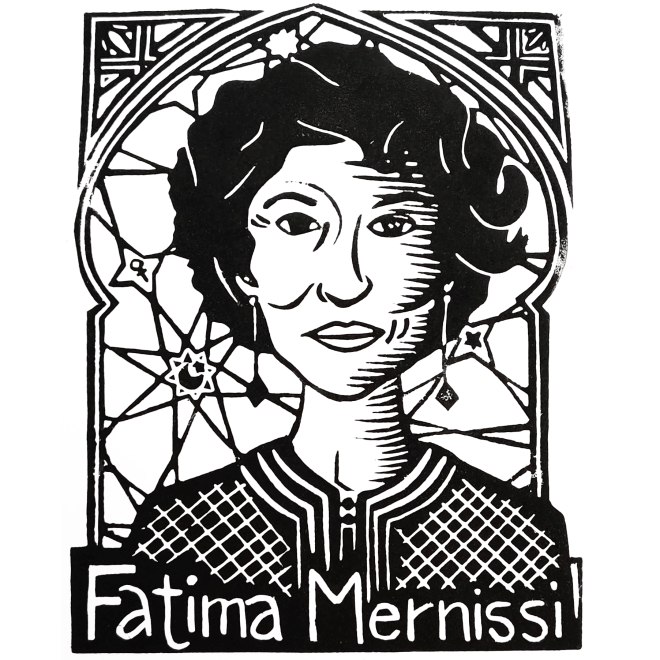
Fatima was a Moroccan sociologist and pioneer of Arabic and Muslim feminism. She grew up in the 1940s/50s in the harem of her paternal grandmother in Fez, Morocco. Her mother and grandmother were illiterate and made sure that, unlike themselves, Fatima had a chance at a different life. It worked. Fatima studied in France and taught at US and Moroccan universities. She wrote many books and articles, largely focused on the position of women within Islam. In her work, she discussed topics such as the strict separation of men and women, human rights and democracy in general in the Arab and Muslim worlds.
Fatima offered Muslim women a feminist perspective using the Qur’an, structuring arguments from within Islam. Her work explored how Islamic thought had developed over time and what this meant in modern settings. She wasn’t against Islam, but against the political power structure that developed around it. In 1988, after the election of Benazir Bhutto as Prime Minister in Pakistan, she was ‘inspired’ by the conservatives who said women cannot or should not lead. She proved them wrong in her book ‘The Forgotten Queens of Islam (1993), which showed that Muslim women have always been involved in socio-political and economic affairs. Though controversial, her work was often respected by critics due to her thorough knowledge of the Qur’an.
We Muslim women can walk into the modern world with pride, knowing that the quest for dignity, democracy, and human rights, for full participation in the political and social affairs of our country, stems from no imported Western values, but is a true part of the Muslim tradition.
Fatima Mernissi, from ‘The veil and the male elite’
Fatima was also critical of the West. When discussing her childhood growing up in a harem, she noticed that Westerners often started giggling. This made her realise that Westerners had a very different understanding of what a harem is. It refers to the separation in the house of the public sphere for men and the more private sphere run by women. In the West, the harem was often sexualised, driven by images of Orientalism, where women supposedly walk around naked at the beck and call of men. This is not the harem Fatima referred to. It highlighted, as just one example, the incorrect assumptions made about Muslim women and the world they inhabit. Where in the Arabic world the bodies of women are an extension of the family’s or husband’s honour, Fatima felt that in the West women are culturally objectified and held to unattainable standards.
Fatima Mernissi’s work shows that feminism does not have to be Western, Eurocentric and anti-religious – it can be so much more.
ALSO LOOK UP
Other thinkers in this field include Amina Wadud, Leila Ahmed, Azizah al-Hibri, Riffat Hassan, Asma Lamrabet, and Asma Barlas. Nana Asma’u was also a scholar who valued both Islam and the rights of women.
SOURCES AND OTHER MEDIA
- ‘Mijn eerste feministische liefde: Fatima Mernissi’, Nadia Ezzeroili, 2016: https://www.volkskrant.nl/cultuur-media/mijn-eerste-feministische-liefde-fatima-mernissi
- ‘Pioneering Muslim feminist writer Fatima Mernissi dies’, BBC News, 2015: https://www.bbc.com/news/world-africa-34968022
- ‘Fatema Mernissi: The Pride of Islamic Feminism in Modern Times’, Mohammed Hashas, 2015: https://musliminstitute.org/freethinking/gender/fatema-mernissi-pride-islamic-feminism-modern-times-obituary
- ‘Fatima Mernissi obituary’, Gayatri Devi, 2015: https://www.theguardian.com/world/2015/dec/18/fatima-mernissi-obituary
- ‘Feminisme in Marokko: Fatima Mernissi maakte zich boos over hoe er in het westen wordt gekeken naar islamitische vrouwen’, BNNVARA, 2021: https://www.nporadio1.nl/fragmenten/de-nieuws-bv/b35faf9f-6462-44d0-a34b-a9215603b536/2021-08-13-feminisme-in-marokko-fatima-mernissi-maakte-zich-boos-over-hoe-er-in-het-westen-wordt-gekeken-naar-islamitische-vrouwen
 Brain & Guts