
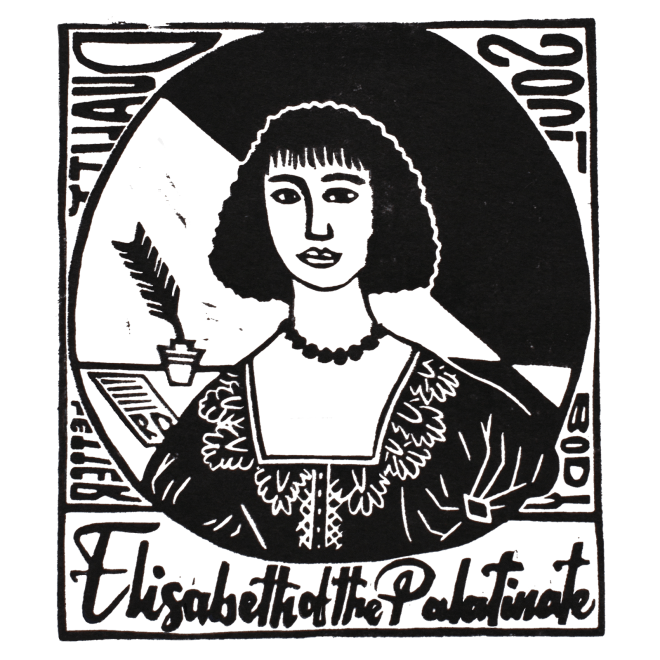
Princess Elisabeth of the Palatinate was born in 1618 into a world of war and exile. Her father, Frederick V – also called the “Winter King” of Bohemia – lost his crown after only one season, forcing the family into years of displacement during the Thirty Years’ War. Raised as a Calvinist a century after the Reformation, Elisabeth received an unusually broad education for a woman, studying in theology, mathematics, languages, and philosophy. Despite her princess title, her life was not necessarily one of luxury; the family’s displacement meant her circumstances were often uncertain.
While living in The Hague, Rijswijk, and later Heidelberg, Elisabeth developed a network of correspondences with Europe’s leading thinkers. She exchanged letters with prominent scholars such as Anna Maria van Schurman and, most notably, René Descartes. In these letters, Elisabeth questioned, challenged, and pressed for answers. Her willingness to challenge established ideas comes across clearly.
Her most famous challenge targeted Descartes’ theory of mind–body dualism. Descartes had claimed that mind and body were two different substances, one immaterial and one physical, yet somehow intertwined. To Elisabeth, who lived with the consequences of real political pressure, illness, and emotional strain, this was a lived contradiction. So she wrote to him, not with deference but with precision: if the mind is immaterial and the body is physical, how can either influence the other? Elisabeth felt that Descartes never answered this satisfactorily and pushed him to reconsider key parts of his philosophy. Descartes tried to answer her, then tried again, but she kept pressing until even he admitted the difficulty. In their letters, you can almost feel him recalibrating, forced to rethink ideas he had once treated as settled. Their correspondence heavily influenced Descartes’ work. So much so that he dedicated his ‘Principles of Philosophy’ to Elisabeth, and his final work, The Passions of the Soul, was written at her request.
Her curiosity didn’t stop at metaphysics. She worried about moral life too: how fairness can exist when human knowledge is always incomplete. And woven through her reflections is something startlingly intimate: her own descriptions of “sadness,” a heaviness that today we might call depression. She didn’t hide it. Instead, she used it as a lens, a way of asking what a good life looks like when the mind itself can be a source of suffering.
Elisabeth never published any of her writing during her lifetime, and her full correspondence, including her letters with Descartes, did not appear until 1879 and were not translated into English until 2007. As a result, her philosophical contributions were long overlooked. Most of her work only survives in letters, common for women of her time, yet these letters reveal a sharp, fearless mind attuned to the tensions between thought and lived experience. During her life, she was known not only for her intelligence and learning but also for her generosity, compassion, and her support for Protestants fleeing persecution. Reading her correspondence today, you sense someone who stood at the crossroads of metaphysics and morality, asking questions that still echo in our debates about consciousness, justice, and what it means to be human.
Also look at:
Anna Maria van Schurman corresponded with Elisabeth.
Sources and other media:
- https://modernreformation.org/resource-library/web-exclusive-articles/the-mod-elisabeth-of-the-palatinate-and-the-mind-body-problem/
- https://historyofwomenphilosophers.org/project/directory-of-women-philosophers/simmern-van-pallandt-elisabeth-1618-1680/
- https://www.cambridge.org/core/books/cambridge-descartes-lexicon/elisabeth-princess-of-bohemia-16181680/ED5565231C61961255841761446C6195
- https://shethoughtit.ilcml.com/biography/elisabeth-of-the-palatinate/
- https://plato.stanford.edu/entries/elisabeth-bohemia/
- https://podcasts.apple.com/ie/podcast/elisabeth-of-bohemia/id1535502137?i=1000632843027
 Brain & Guts