
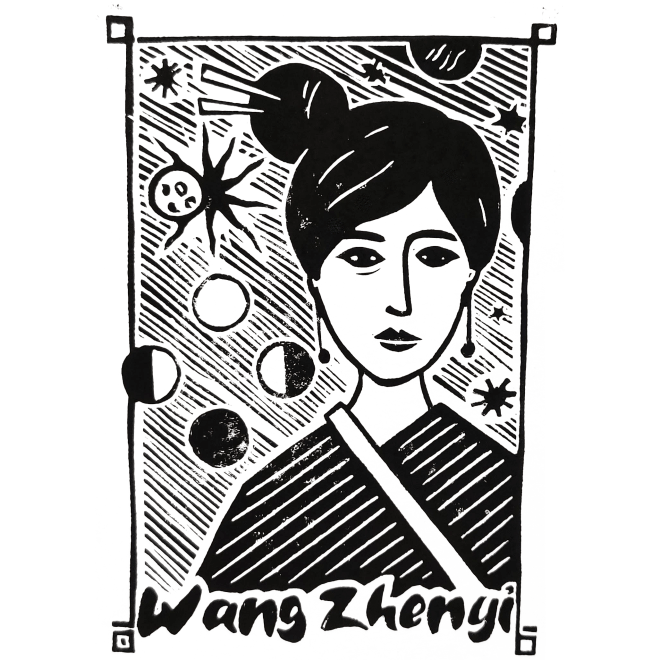
Wang Zhenyi (1768–1797) was a Chinese astronomer, mathematician, and poet of the Qing dynasty who pursued scholarship at a time when formal education for girls was rare. Raised in a scholarly family in Nanjing, she was taught astronomy by her grandfather, medicine, mathematics and geography by her father, and poetry by her grandmother, while her extensive travels and access to a large family library broadened her intellectual world even further. She even learned equestrian skills, archery, and martial arts from the wife of a Mongolian general named Aa, giving her an unusually diverse education for her era.
Her most significant contributions were in astronomy and mathematics: she conducted careful studies of celestial events such as equinoxes and lunar eclipses, explaining them through clear, hands‑on demonstrations using mirrors, lamps, and globes to show how the Earth and Moon cast shadows. She wrote works like ‘Dispute of the Procession of the Equinoxes’, ‘Dispute of Longitude and Stars’, and ‘The Explanation of a Lunar Eclipse’, all aimed at making complex astronomical ideas accessible. In mathematics, she produced straightforward instructional texts (including a five‑volume guide to calculation aged only age twenty‑four) that simplified difficult theories and helped beginners learn trigonometry and arithmetic. Beyond science, she wrote poetry that often highlighted the hardships of working women, leaving behind thirteen volumes of poetry, prose, and commentary.
Although she died at only twenty‑nine, she ensured her manuscripts were preserved by entrusting them to a friend, who later passed them to a nephew who helped finalise the publication of ‘Simple Principles of Calculation’. Wang Zhenyi was a woman who challenged restrictive gender norms, committed to making knowledge available to others and gave a voice to women. Her legacy is suitably honoured on Venus: a crater now bears her name.
Also Look up
Other 18th century women of science include Émilie du Châtelet (mathematician, physicist, and translator. She worked on kinetic energy, and argued for the importance of women’s education); Caroline Herschel (A pioneering astronomer who discovered eight comets), Maria Gaetana Agnesi (an Italian mathematician and philosopher who’s said to have written the first woman to write a mathematics handbook that gained international recognition), Laura Bassi (another Italian physicist and academic, the first woman in Europe to earn a university professorship); Maria Sibylla Merian (a naturalist and scientific illustrator); or Mary Somerville (a Scottish scientific writer whose mathematics, astronomy and creativity helped coin the term ‘scientist’).
Sources and other media
- Article: https://time.graphics/period/1650435
- Article: https://www.theworldofchinese.com/2014/10/badass-ladies-of-chinese-history-wang-zhenyi/
- Article: https://thefoldingchairhistory.com/2018/07/10/wang-zhenyi-the-creative-genius-who-made-science-rule/
- Article: https://www.sheisanastronomer.org/history/wang-zhenyi
- Article: https://massivesci.com/articles/wang-zhenyi-poetry-venus-math/

 Brain & Guts